


This week (ended on 24th April, 2026) saw both gold and silver give back a meaningful portion of their recent gains, with the global macro backdrop supplying clear headwinds on multiple fronts simultaneously. The primary driver was the interplay between a rebounding US dollar, persistently elevated inflation expectations, and rising uncertainty around the FOMC meeting on April 28-29 — Powell’s final meeting as Fed chair before Kevin Warsh takes over on May 15.
| Metal | This Week (Apr 24) | Last Week (Apr 17) | Change (₹/$) | Change (%) |
| Gold — MCX (₹ per 10g) | ₹1,52,699 | ₹1,54,609 | −₹1,910 | −1.2% |
| Silver — MCX (₹ per kg) | ₹2,44,636 | ₹2,57,142 | −₹12,506 | −4.9% |
| Gold — COMEX ($ per oz) | $4,740.9 | $4,868.0 | −$127.1 | −2.6% |
| Silver — COMEX ($ per oz) | $76.4 | $82.5 | −$6.1 | −7.4% |
Note: All prices are Friday April 25 futures closing prices. MCX prices in INR, COMEX prices in USD. Grey rows are international reference prices. COMEX declines are larger than MCX declines this week as rupee weakness cushioned domestic prices.
On inflation, the University of Michigan’s April reading showed consumer inflation expectations surging to 4.8%, a full percentage point jump from March and the largest single-month spike in over a year. This is significant for precious metals because it reinforces the ‘higher for longer’ rate narrative — even as the market prices a 99.5% probability of a hold at 3.50-3.75% next week, the path to cuts later in 2026 is narrowing. The Fed faces a genuine policy trap: cutting risks reigniting inflation, holding risks slowing an economy already showing signs of fatigue, with the Atlanta Fed’s GDPNow model tracking Q1 2026 growth at just 1.24%.
The Strait of Hormuz situation added a whipsaw element. Trump extended the ceasefire on April 22, briefly softening oil prices and the dollar. But the US naval blockade on Iranian port traffic remains firmly in place, and on the same day Iran’s IRGC seized two commercial vessels in the strait — a blunt reminder that the underlying conflict is unresolved. Oil is hovering near $106-107 per barrel, keeping energy-driven inflation elevated and limiting the Fed’s room to sound dovish. For India, the rupee’s role as a price cushion was clearly visible this week. COMEX gold fell 2.6% in dollar terms, while MCX gold fell only 1.2% in rupee terms. The rupee weakened to around ₹94.2 per dollar by Thursday — a four-week low, down roughly 1.3% on the week — partly absorbing the global price decline for domestic buyers. The RBI has been selling dollars intermittently to limit volatility but is not defending a fixed level. The structural message is unchanged: a weakening rupee acts as a floor under MCX prices relative to COMEX, but it is not a substitute for a genuine directional move in international prices.
Gold | MCX GOLD1!
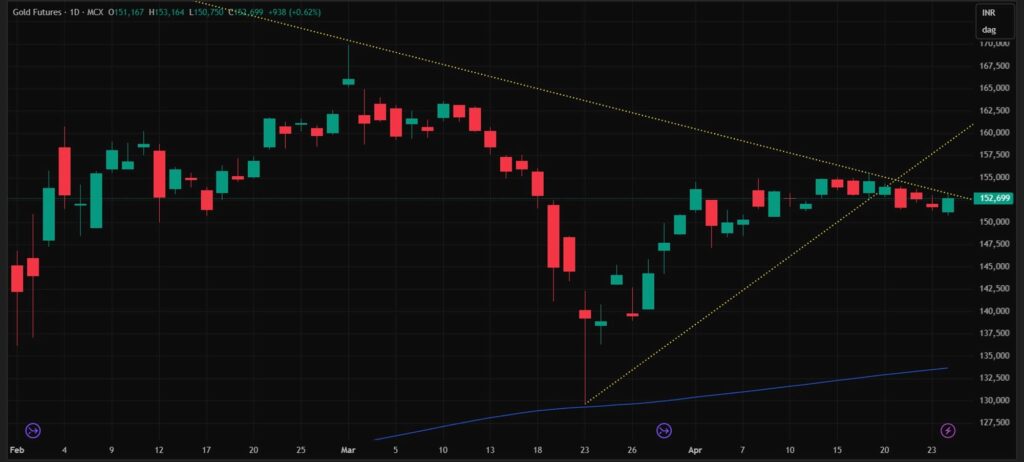
MCX Close (Apr 24): ₹1,52,699 per 10g Prior week (Apr 17): ₹1,54,609 Change: −₹1,910 (−1.2%) | ATH: ₹1,80,779 200 EMA: ~₹1,32,500
Last week’s article flagged that gold was compressing inside a symmetrical triangle — rising support from the March lows converging with falling resistance from the January ATH — and that a directional move was close. That move has now arrived, and it has been to the downside. Price has slipped below the rising support trendline, breaking the pattern of higher lows that had been intact since the late-March base.
The breakdown is gradual rather than sharp, which matters. A violent breakdown would signal panic selling and strong conviction to the downside. This week’s drift lower instead suggests exhaustion — buyers who had been holding the rising support simply stepped away as the macro headwinds stacked up. Gold at ₹1,52,699 is now back below the triangle’s lower boundary and sitting roughly 15.5% below the January ATH of ₹1,80,779. The 200 EMA at around ₹1,32,500 remains well below, confirming the long-term structural uptrend is intact — this is a correction within a bull market, not a trend reversal.
One important buffer specific to India this week: the rupee’s weakness meant domestic gold prices fell significantly less than COMEX. This cushioning effect is temporary and depends on continued rupee softness, but it has real-world implications for jewellers and importers managing procurement costs on a week-to-week basis.
| Key Takeaway: Gold has exited the triangle to the downside, shifting the short-term bias from neutral to mildly bearish. The ₹1,50,000 level is now the key support to watch — a break below that with any conviction would open the door to ₹1,47,500-48,000. For jewellers, this week’s modest price decline in INR terms is a better buying opportunity than it looks in the headlines, given the rupee cushion effect. The FOMC meeting on April 28-29 is the next major catalyst — a hawkish Powell could extend the decline, while any dovish signal would likely spark a sharp recovery. |
Silver | MCX SILVER1!
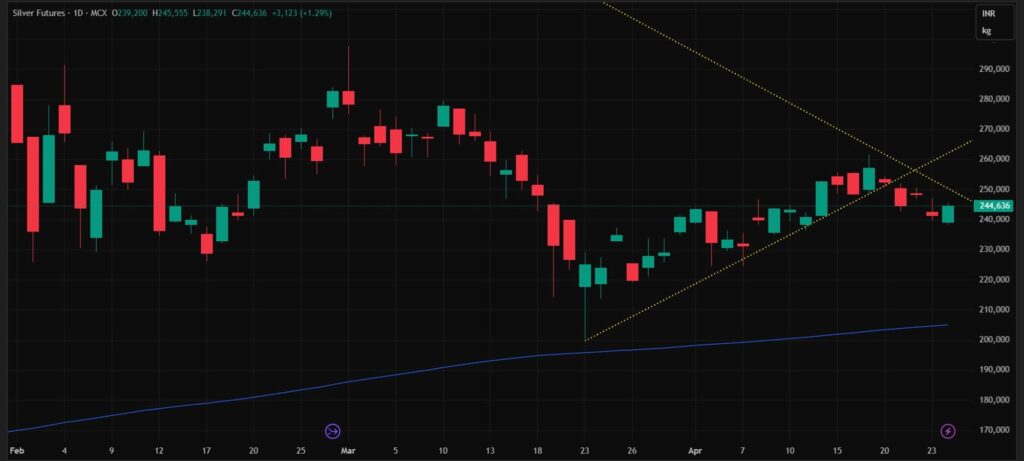
MCX Close (Apr 24): ₹2,44,636 per kg Prior week (Apr 17): ₹2,57,142 Change: −₹12,506 (−4.9%) | ATH: ₹4,20,048 200 EMA: ~₹2,01,500
Silver’s breakdown is cleaner and more decisive than gold’s. Last week silver was pressing actively against the falling resistance trendline — the more aggressive of the two triangle structures. This week that aggression reversed entirely. Price has not just broken below the rising support line; it has also printed a sequence of lower highs in the last few sessions, indicating that sellers are in control rather than buyers simply stepping back.
The COMEX picture amplifies this: silver fell 7.4% in dollar terms this week, from $82.5 to $76.4 — nearly 2.8 times gold’s 2.6% dollar decline. Silver’s dual nature as both safe-haven and industrial metal works both ways. The same industrial demand angle that drove silver’s 5.7% outperformance last week became a liability this week as ceasefire optimism and growth concerns converged. The gold-silver ratio has widened sharply back toward 62 from last week’s 59, unwinding the compression that had been signalling improving risk appetite.
The rupee cushion that protected MCX gold buyers this week was less effective for silver — the 4.9% MCX decline versus 8.6% COMEX decline still represents meaningful pain. The key support zone identified last week at ₹2,40,000-2,35,000 is now being tested. The 200 EMA at approximately ₹2,01,500 remains a distant structural floor.
| Key Takeaway: Silver’s breakdown is the more concerning of the two charts — lower highs, downside follow-through, and a sharp widening of the gold-silver ratio in a single week. For trade participants with silver exposure, ₹2,35,000-40,000 is the support zone to watch. A sustained break below ₹2,35,000 would suggest the recovery from the March lows has fully reversed. On the upside, any dovish FOMC signal or credible Hormuz de-escalation would likely see silver recover faster and sharper than gold — but that catalyst needs to arrive first. |
Watch Next Week:
- FOMC — April 28-29 (Powell’s final meeting): The rate decision is settled at 99.5% probability of a hold. Every word of the statement and press conference is a signal. Does Powell acknowledge any path to cuts in 2026? Does he flag the Hormuz-driven inflation as transitory or structural? This is also his final meeting — any exit language that hints at Fed direction under Warsh will move gold immediately.
- Kevin Warsh confirmation: The DOJ dropped its probe of Powell on April 24, sending Warsh’s Polymarket confirmation odds from 27% to 85% in a single session. Gold rose on the news — markets were pricing a Fed independence discount that has now partially cleared. Warsh’s own testimony acknowledged the Fed’s 2021-22 inflation policy errors. His first signals as chair-designate will matter for the medium-term gold narrative.
- US Q1 2026 GDP — April 30: With GDPNow tracking Q1 growth at just 1.24%, a weak print would add stagflation pressure to the macro narrative — structurally positive for gold as a hedge, but complicated by the yield effect. A surprise to the upside would support the dollar and weigh on metals.
- Hormuz and oil: Trump has reportedly indicated willingness to end the confrontation with Iran even without full Hormuz restoration. Any credible progress here pulls oil lower, eases inflation expectations, and potentially gives the Fed room to sound less hawkish — the single most powerful positive catalyst for both metals right now.
- MCX key levels to watch: Gold: ₹1,50,000 support — a break below with volume would be a bearish signal. Silver: ₹2,35,000-40,000 zone — this needs to hold for the recovery narrative to remain intact.
Disclaimer: This article is for informational purposes only and does not constitute investment or trading advice. All prices are futures closing prices — MCX in INR, COMEX in USD. Past performance is not indicative of future results.