


Macro Snapshot: The rate backdrop eased during the week ending 23 October, which makes the metals’ slide harder to explain. CME FedWatch odds of a hike at the 27 to 28 October FOMC meeting had settled near one in three on 14 October, after the 3.7% September CPI print, and stood at 9.4% by 23 October. December hike odds slipped from about 90% to close to 80%. The 10-year Treasury yield closed at 5.00% against 5.09% a week earlier, and the 30-year at 5.33% against 5.43%. Gold still fell 4.1% on COMEX and silver 5.9%.
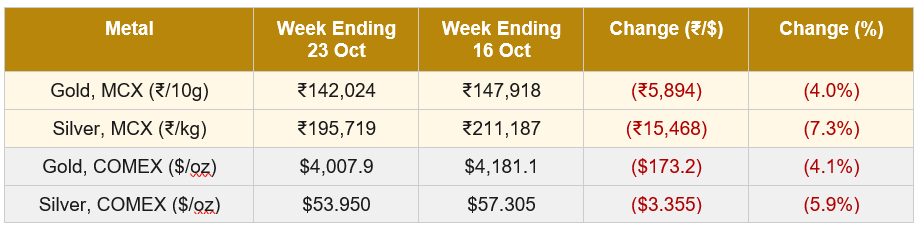
The explanation lies in what else was falling. The Nasdaq dropped 2.6% on 22 October as Meta’s spending plans revived doubts about the AI trade, and COMEX December gold futures lost 2.2% in the same session even as the 10-year yield fell 17 basis points, the reverse of the usual relationship. Global X’s Justin Lin, quoted by Forbes, called it a liquidity-driven selloff, and the pattern fits: when equity losses force margin calls, gold and silver are sold because they can be, whatever yields are doing.
Oil kept the December hike in play. Brent settled at $116.72 a barrel on 23 October, its highest close since 29 April and 6% above the prior Friday, after Houthi attacks on Saudi targets, including energy infrastructure, prompted Saudi Aramco to evacuate its Dhahran headquarters. WTI settled at $103.27, up 2.3% on the week, and Saxo Bank’s Ole Hansen, cited by Forbes, blamed the inflationary impact of energy prices for the pressure on metals.
The rupee ended where it began. After closing at 94.89 per dollar on 16 October, it rallied to a six-week high of 94.38 on 21 October on inflows tied to the ₹30,213 crore Jio Platforms IPO and RBI steps to curb oil companies’ dollar demand. Rising Brent and net equity sales of ₹3,458.70 crore by foreign institutional investors on 22 October then erased the gain, and it closed at 94.93. With the currency flat, MCX gold’s 4.0% fall matched COMEX’s 4.1%, and Indian holders received no rupee cushion.
Gold-specific drivers: Physical buyers paid up even as volumes lagged. Indian dealers charged premiums of up to $9 an ounce over official domestic prices in the week ending 23 October, against up to $7 a week earlier, as Dussehra brought customers back. The Indian Bullion and Jewellers Association, however, estimated Dussehra purchases ran 7% to 10% below the prior year. Much of the metal is coming from customers’ own holdings: GJC vice chairman Avinash Gupta said old-gold exchange now accounts for about half of purchases against a traditional 30%, and September gold imports fell to $1.8 billion from $9.61 billion a year earlier.
Silver-specific drivers: India reopened the import tap in size. Bullion dealers received permits to import about 6,500 tonnes of silver over six months, Reuters reported on 22 October, after the government restricted silver imports in nearly all forms in mid-May and raised duty to 15% from 6%. Amrapali Group Gujarat’s Chirag Thakkar said the allocation exceeds what the country is likely to need. Local premiums fell to 45 cents an ounce on 22 October from as much as $2.50 a week earlier, dealers reported that festive demand had yet to arrive, and Indian silver ETFs fell as much as 5% on 23 October. With the rupee flat, MCX silver’s 7.3% fall against COMEX’s 5.9% is consistent with that premium unwinding, and the gold-silver ratio on the closing figures above widened to about 74.3 from 73.0.
Gold | MCX GOLD1!
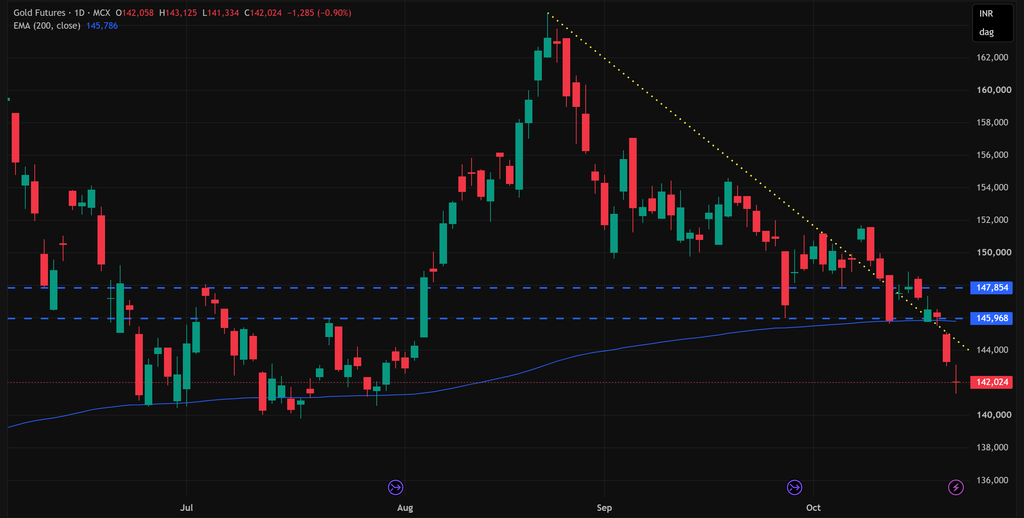
MCX gold has set lower highs since its late-August peak, and its one move above the descending trendline drawn from that top, in mid-October, failed within two sessions. Beneath those rallies, the ₹145,968 to ₹147,854 band served as the floor through October. The December contract, which the continuous chart has tracked since the 5 October rollover, tested it in mid-October and held, and the week ending 16 October closed at ₹147,918 at its upper edge.
The week ending 23 October broke it. A wide-range session on 22 October, which closed at ₹143,309, carried price through the whole band and below the 200-day EMA at ₹145,786, and Friday’s narrow session, with a low of ₹141,334 and a close of ₹142,024, showed hesitation rather than recovery.
Older levels on the chart need adjusting before they mean anything. The July and early August lows near ₹140,000 to ₹141,000 were printed on the August contract, two rollovers ago; using the current 1.75% gap between the December and February contracts as a guide to the cost of each roll, those lows sit near ₹145,000 in December-contract terms. On that basis the summer base and the October floor are one zone, and Friday’s close is below every low on this chart since June. The 200-day EMA, built partly from cheaper expired contracts, understates the true trend average for the same reason.
Two closes below the zone and no retest yet make this an early breakdown. A daily close back above ₹145,968 would turn it into a failed breakdown; until then, the zone is resistance and the chart shows no adjusted support beneath price.
| Key Takeaway: In December-contract terms, the floor that broke is both the October floor and the summer base, a single ₹145,000 to ₹148,000 zone. Jewellers restocking ahead of Dhanteras on 6 November are buying below it, which is an opportunity only if price reclaims the zone; until then, the chart offers no nearby floor. |
Silver | MCX SILVER1!
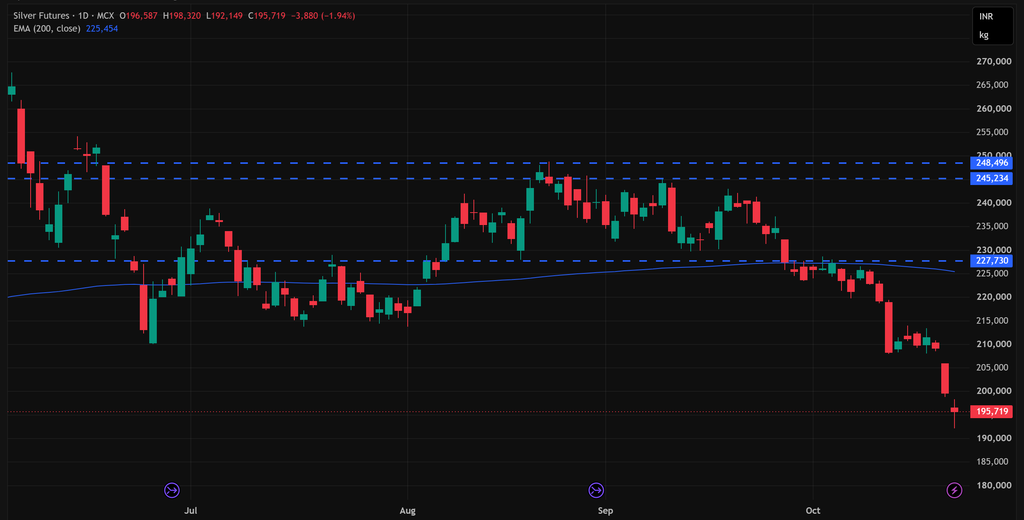
Silver broke first and has fallen further. Through August and September, MCX silver held a range between ₹227,730 and a ceiling at ₹245,234 to ₹248,496. The September trading and the October retests all came on the December contract, which the continuous chart has tracked since the 4 September expiry, so the breakdown below ₹227,730 in late September and the failed attempts to recover it in early October need no adjustment.
Mid-October brought a wide-range drop to about ₹208,000 and a four-session pause between ₹208,000 and ₹213,000, then two expansion sessions took price below ₹200,000, with Friday opening at ₹196,587 beneath Thursday’s ₹199,599 close. Friday’s low of ₹192,149 drew buyers and the close came well off it, but a single lower wick is a reaction, not a reversal.
The June lows near ₹210,000 came on the July contract, two rollovers back. Using the current 3.2% gap between the December and March contracts as a guide, they sit roughly 5% higher in December-contract terms, near ₹220,000, which puts Friday’s close about 11% below the lowest point of this chart on a like-for-like basis. The 200-day EMA at ₹225,454 is turning lower and understates the gap for the same reason as gold’s. The read is a confirmed breakdown that is still accelerating, with the first ceiling on any bounce between ₹200,000 and ₹208,000.
| Key Takeaway: Silver has lost its range, its trend average and, within a single week, most of its local premium. Stockists should treat any bounce toward ₹200,000 to ₹208,000 as a test of resistance rather than a recovery, at least until premiums show festive demand absorbing the new import supply. |
Watch in the Days Ahead
- FOMC, 27 to 28 October: A hold is priced at about 90%. With the metals falling on liquidity rather than rates, a hawkish statement that rattles equities again could bring more forced selling, while a softer one helps only if margin pressure has passed.
- Equity volatility: Watch gold on days when yields fall. A rally there would signal the liquidity sale is exhausted.
- Brent above $115: Further attacks on Saudi infrastructure keep the December hike priced and would pressure the rupee, cushioning MCX against COMEX.
- Silver premium into Dhanteras (6 November): A return of local premiums would show festive demand absorbing the permits.
- Levels: Gold resistance at ₹145,968 to ₹147,854. Silver support at Friday’s ₹192,149 low, resistance at ₹200,000 to ₹208,000.
Disclaimer: The views expressed are for informational purposes only and do not constitute investment advice or a recommendation to buy or sell any commodity or derivative. Readers should consult a qualified adviser before making investment decisions.
Authored by Dhawal Chotai