


Macro Snapshot: The week ending May 15 was the most consequential week of the year for the Indian gold and silver trade, not because of what happened to international prices, but because of what happened in India. Two simultaneous shocks reshaped the domestic market: a near 1.6% rupee depreciation to a fresh record low of 95.98 per dollar on Friday, and a Wednesday government decision to raise the gold and silver import duty from 6% to 15%, followed by a Thursday cap of 100kg on duty-free gold imports under the Advance Authorisation scheme. The combined effect was to push MCX gold up 3.9% and MCX silver up 3.8% on the week, even as their COMEX counterparts fell 3.6% and 4.1% respectively. This is the rupee story week, and it has direct, immediate, and unavoidable consequences for every Indian jeweller, exporter, and importer.
| Metal | Week Ending May 15 | Week Ending May 8 | Change (₹/$) | Change (%) |
| Gold, MCX(₹/10g) | ₹1,58,547 | ₹1,52,530 | +₹6,017 | +3.9% |
| Silver, MCX (₹/kg) | ₹2,71,886 | ₹2,61,922 | +₹9,964 | +3.8% |
| Gold, Comex($/oz) | $4,561.9 | $4,730.7 | −$168.8 | −3.6% |
| Silver,Comex($/oz) | $77.55 | $80.87 | −$3.32 | −4.1% |
Note: All prices are Friday May 15 futures closing prices. The clear divergence this week, COMEX prices fell sharply while MCX prices rose meaningfully, is almost entirely explained by a record-low rupee and the steepest gold import duty hike in years.
On the international side, the picture was bearish. US wholesale inflation surged at its fastest pace since 2022 in April, while consumer prices posted their largest increase since 2023. Markets have now fully ruled out a Fed rate cut in 2026, with some traders pricing a hike by December. The Iran negotiations remained at a standstill, Trump publicly described the ceasefire as fragile, citing unresolved disputes over sanctions, oil exports and military activity. Brent crude held around $107 per barrel, keeping the inflation pipeline full. The combination of accelerating US inflation, a stronger dollar, rising Treasury yields, and stalled Iran diplomacy pushed COMEX gold and silver sharply lower for the week.
In India, the rupee bore the full force of these global dynamics. The currency hit successive record lows, 95.6 on Wednesday, 95.75 on Thursday, and 95.9 on Friday, the third consecutive session at a fresh low. The RBI intervened intermittently but, with over $100 billion of forex reserves already spent on rupee defence this year, the firepower is no longer unlimited. The pressure was structural: a strong dollar bid globally, persistent FPI outflows from Indian equities (over ₹1.07 trillion sold YTD), elevated oil import bills, and weakening domestic economic fundamentals. State-run fuel retailers raised petrol and diesel prices for the first time in four years, signalling that the energy shock is now feeding directly into household inflation. In response, the government took action on the gold and silver import side. Effective May 13, the basic customs duty on gold and silver was doubled to 10%, the Agriculture Infrastructure and Development Cess was raised fivefold from 1% to 5%, taking the total effective import duty to 15% from 6%. Adding the 3% IGST, the total levy on bullion imports is now 18.45%, up from 9.18% earlier, effectively doubled overnight. On May 14, the DGFT capped gold imports under the Advance Authorisation scheme (the duty-free route used by jewellery exporters) at 100kg per licence, and made first-time applicants subject to mandatory physical inspection of manufacturing units. India’s gold imports surged 24% to a record $71.98 billion in FY26, and gold-silver imports together hit $102.5 billion or 14% of total imports. This is the government saying: enough.
Gold I MCX Gold1 I
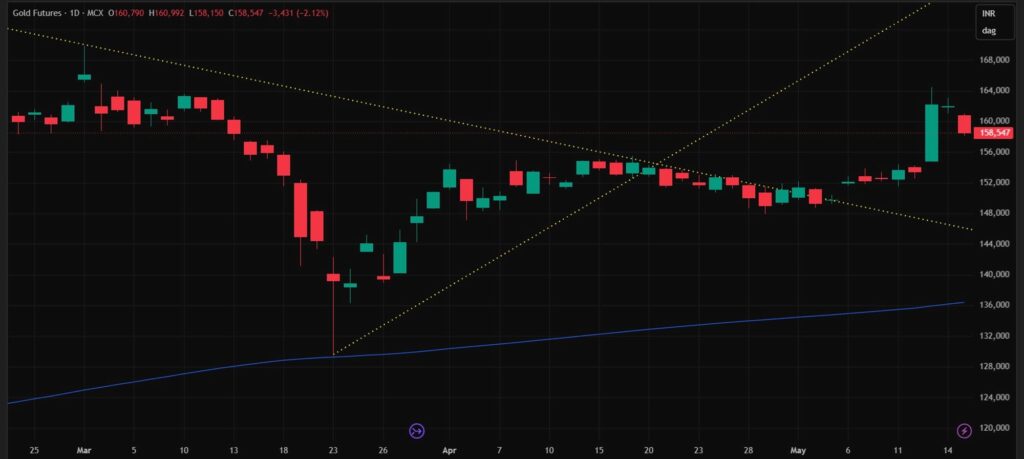
Gold has materially improved its technical structure this week. After several sessions of narrow consolidation around ₹1,48,000-1,54,000, price expanded above that range with a strong impulsive candle mid-week. The declining trendline resistance from the late-January all-time high has now been clearly broken, price is no longer inside the prior compression pattern. The breakout is structurally valid as long as price holds above the former range ceiling around ₹1,54,000-1,56,000.
However, the last two candles show clear rejection from the immediate supply zone near ₹1,62,000-1,64,000. The latest red candle has pulled price back to ₹1,58,547, showing that buyers lost momentum after the initial breakout. This is not yet a failed breakout because price is still above the old range and above the broken trendline. It is better read as a breakout followed by a supply reaction. Structure has shifted from flat consolidation to early higher-high behaviour, but confirmation now depends on whether the pullback holds above the breakout zone rather than slipping back into the old range.
There is a critical caveat for Indian readers: roughly half of this week’s MCX gain is mechanical, not directional. With COMEX gold down 3.6% in dollar terms and the rupee down 1.6%, plus the 9-percentage-point duty differential now in place, the MCX move overstates underlying demand strength. The duty hike alone effectively re-rates domestic gold pricing upward by around 9 percentage points relative to international parity, and that re-rating took place over Wednesday and Thursday’s sessions. The technical breakout above the trendline is real and structurally significant, but the magnitude of the move needs to be read with the rupee and duty context firmly in mind.
| Key Takeaway: Gold attempted breakout and has achieved an initial range expansion, but the move is facing rejection from ₹1,62,000-1,64,000 supply. As long as ₹1,54,000-1,56,000 holds, this is a pullback after breakout, not a failed breakout. For jewellers and exporters: the duty hike means landed cost of gold has structurally repriced upward. Inventory in hand is more valuable today than it was on Tuesday; replacement cost on new imports is meaningfully higher. Procurement decisions need to factor in both rupee direction and policy stability, both are now active variables, not background assumptions. |
Silver I MCX Silver1 I
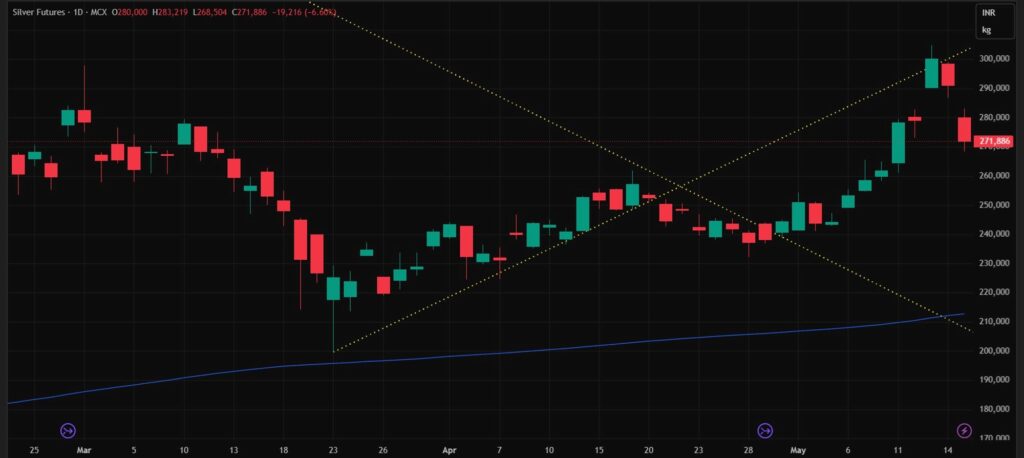
Silver continued its outperformance initially, with a sharp extension above the prior breakout zone and a move toward the ₹2,95,000-3,00,000 area mid-week. The broader breakout above the declining trendline remains technically valid, but the latest candles show clear rejection from higher supply. Price failed to sustain the move near ₹3,00,000 and closed sharply lower at ₹2,71,886, with Friday delivering a 6.6% intraday decline.
The last two candles are important to read carefully. The first showed exhaustion near the upper extension zone, and the latest candle confirms strong selling pressure rather than a normal pause. This does not yet break the broader bullish structure, price remains above the earlier ₹2,55,000-2,62,000 breakout area, but the immediate upside extension has failed, and momentum has shifted from expansion to corrective selling. Demand should now be watched around ₹2,60,000-2,65,000. A hold there would keep the breakout structure intact; acceptance below that zone would start converting this from a pullback into an early breakdown.
The COMEX context is illuminating. Silver fell 4.1% in dollar terms on COMEX this week, similar in magnitude to MCX silver’s 3.8% gain in rupee terms. This is the cleanest week of the year to see the rupee-and-duty cushion at work: a roughly 8 percentage point swing between the two exchanges, almost entirely explained by INR depreciation and the duty hike. For trade participants with silver exposure, the more important question is whether the international correction continues. Iran negotiations at a standstill and accelerating US inflation argue for continued pressure; a Hormuz peace breakthrough would be the catalyst for reversal.
| Key Takeaway: Silver shows a failed breakout at the upper extension zone near ₹2,95,000-3,00,000, but not a confirmed breakdown of the broader bullish structure yet. The trend remains stronger than gold on a medium-term basis, but short-term momentum has clearly reversed from overextended to corrective. For trade participants, the ₹2,60,000-2,65,000 zone is the structural line in the sand. A hold there keeps the breakout narrative intact; a break below opens the path back toward ₹2,40,000-2,45,000. Silver’s relative strength versus gold has begun to fade, partly because the Hormuz upside has been priced and rejected, and partly because the duty hike applies equally to both metals, there is no silver-specific structural advantage from the policy change. |
Special Focus | The Import Duty Hike and What It Means:
This week’s policy change is the most significant India gold story of 2026 so far. The mechanics deserve careful attention because the implications are not symmetrical across the trade.
What changed: Effective May 13, the total import duty on gold and silver rose from 9.18% to 18.45% (basic customs duty doubled from 5% to 10%, Agriculture Cess raised from 1% to 5%, with the existing 3% IGST unchanged). Effective May 14, gold imports under the Advance Authorisation scheme were capped at 100kg per licence, with mandatory physical inspection of manufacturing units for first-time applicants. Fresh import permissions are now linked to fulfilment of at least 50% of prior export obligations.
Why it happened: India’s gold imports surged 24% in FY26 to a record $71.98 billion. Combined gold-silver imports of $102.5 billion represent 14% of total imports. With the rupee under sustained pressure and forex reserves already meaningfully depleted from RBI intervention, the import bill is no longer sustainable at current consumption levels. Prime Minister Modi’s recent call for gold purchase restraint signalled the policy direction, and Wednesday’s duty hike was the implementation. The Advance Authorisation cap on Thursday was specifically aimed at preventing arbitrage, importers rushing to bring in large quantities under the duty-free route immediately after the duty hike to profit from the price differential.
Who benefits, who loses: Jewellers and exporters holding existing inventory at the prior duty rate have benefited from an immediate one-time inventory revaluation upward. Importers with pre-duty stock are the clear short-term winners. On the other hand, fresh imports become structurally more expensive. Mass-market jewellers face an immediate procurement cost increase that will be difficult to fully pass on to price-sensitive consumers, especially given that gold demand was already softening on volume terms despite record value growth. The high-end segment is more insulated, customers there have already shown resilience to record prices in Q1.
Second-order effects to watch: First, smuggling. India’s previous duty hike in 2019 led to a measurable increase in illegal gold imports through unauthorised channels. A near-doubling of duty creates strong incentives. Second, the gold loan industry, retail bank loans against gold jewellery were already at ₹4.3 trillion in February, up 124% year-on-year. A revalued domestic gold price expands collateral capacity but also encourages more borrowing against existing holdings rather than fresh purchases. Third, the gold ETF and digital gold markets, both grew explosively in Q1 2026 and may now grow further as physical alternatives become relatively less attractive. Fourth, recycling. Higher domestic prices typically accelerate scrap supply, this is a structural support for jewellers who buy-and-melt, but a structural headwind for fresh-import-dependent operators.
The strategic question: Is this duty hike a temporary measure tied to the current rupee and forex crisis, or a structural policy reset? The 2019 precedent suggests duty hikes tend to be sticky. However, the gems and jewellery export sector employs millions and contributes meaningfully to merchandise exports, structural pressure on the industry will generate political pushback. Watch for clarifications from the Ministry of Commerce on whether the AA scheme cap will be reviewed, and whether any relief measures are introduced for genuine exporters. For now, the prudent assumption is that the higher duty structure will persist for at least the duration of the West Asia crisis, and possibly beyond.
Watch in the Days Ahead:
- Rupee at 96 and beyond: The rupee is now within striking distance of 96 per dollar, with analyst calls for 96-97 in worst-case scenarios circulating. Continued rupee weakness will keep MCX prices supported even if international prices fall further. Watch for RBI commentary on intervention strategy and any signals on capital flow management.
- Policy clarifications on import rules: Industry bodies will likely lobby for relief on the Advance Authorisation cap and for clarity on existing in-transit shipments. Any official commentary or modification of rules in the coming sessions will move MCX prices and inventory valuations immediately.
- Iran negotiations and oil: Trump’s characterisation of the ceasefire as fragile and the standstill on Iran talks keeps oil elevated and inflation pressures intact. Any breakthrough would be sharply bearish for both metals in dollar terms (oil down, Fed room to cut, real yields compress). Continued stalemate keeps the rupee under pressure and MCX prices supported even on weaker international cues.
- Kevin Warsh’s first signals as Fed Chair: Powell’s term as chair expired May 15. Warsh has been confirmed by the full Senate and now takes over a committee with four dissents at its last meeting. Any communication on rate path, particularly around inflation persistence, will move international precious metals immediately.
- MCX key levels: Gold: ₹1,54,000-1,56,000 must hold to keep breakout intact; ₹1,62,000-1,64,000 is the next supply to clear for continuation; ₹1,68,000 is the next major target. Silver: ₹2,60,000-2,65,000 is the structural support that must hold; a break below opens path to ₹2,40,000-2,45,000; on the upside, ₹2,95,000-3,00,000 has now established itself as significant supply.
Disclaimer: This article is for informational purposes only and does not constitute investment or trading advice. All prices are futures closing prices, MCX in INR, COMEX in USD. Import duty rates and regulatory rules are as understood at time of writing; readers should verify current rates with their customs broker or authorised dealer before acting. Past performance is not indicative of future results.
Authored by Dhawal Chotai