


The week ending May 22 was the digestion week. After the policy shock of the previous week (the steepest gold import duty hike on record, a record-low rupee, and a tightening of the Advance Authorisation scheme), price action paused. MCX gold gained just 0.1%, silver was essentially flat. COMEX gold and silver both declined modestly, by 0.8% and 1.7% respectively. The week’s headline numbers reveal almost nothing about what is actually happening in the Indian gold market right now. The real story is in the data.
| Metal | Week Ending May 22 | Week Ending May 15 | Change (₹/$) | Change (%) |
| Gold, MCX(₹/10g) | ₹1,58,679 | ₹1,58,547 | +₹132 | +0.1% |
| Silver, MCX (₹/kg) | ₹2,71,846 | ₹2,71,886 | (₹40) | (0.0%) |
| Gold,Comex($/oz) | $4,523.2 | $4,561.9 | ($38.7) | (0.8%) |
| Silver,Comex($/oz) | $76.20 | $77.55 | ($1.35) | (1.7%) |
Note: All prices are Friday May 22 futures closing prices.
On Friday, May 22, the World Gold Council (WGC) published an India Gold Market Update titled, “Import Tightening”, providing the first systematic analysis of the May 13 duty hike. The findings are worth absorbing carefully, because they shape the actionable read for every Indian jeweller, exporter, and trader. Domestic gold prices have risen only 4% to 6% since the duty change, not the full 9 percentage point increase the duty would imply. Domestic prices are now trading at a record discount of roughly $145 to $150 per ounce versus the official landed price, compared to historical discounts of $15 to $25 per ounce after previous duty hikes. The WGC estimates Indian jewellery and bar and coin demand will decline by 50 to 60 tonnes in 2026, approximately 10% lower than 2025, on account of the duty hike alone.
The rupee weakness story remained intact. The rupee touched a fresh record low of 96.89 on May 20 before recovering modestly to close the week. Foreign institutional investor outflows have crossed $22 billion since the Iran war began in late February, and RBI forex reserves have declined approximately $37 billion from their peak, largely defending the rupee. Treasury markets in India are increasingly pricing the possibility of an RBI rate hike at the June 6 MPC meeting if rupee pressure persists, a notable shift from the previous expectation of continued holds. Whichever way the RBI moves, the precious metals trade will feel it through the rupee channel.
On the international side, gold and silver remained under pressure from rising real yields. The US 10-year Treasury yield closed at 4.59% on May 15, its highest level in months, and remained elevated through the week. Markets continue to price out Fed rate cuts in 2026 entirely, with some traders now pricing the possibility of a rate hike by December. Iran’s Supreme Leader issued a directive that the country’s near-weapons-grade uranium should not be sent abroad, pushing oil 2% higher on Thursday and undermining the brief optimism around US-Iran negotiations. FOMC minutes released May 21 reinforced concerns about inflation persistence, particularly given the ISM Prices Paid surge to 84.6 in April.
Gold | MCX GOLD1!
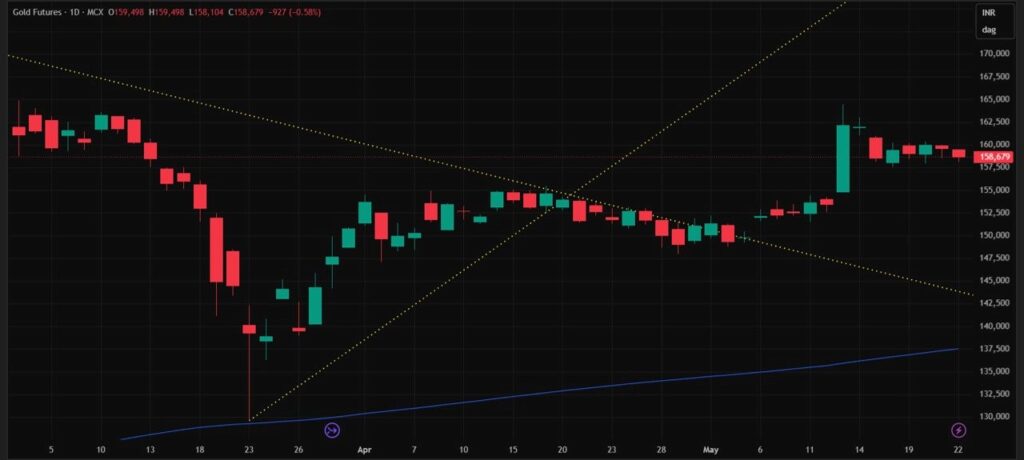
Gold has held above the prior breakout area but the breakout has not extended. After the strong expansion candle into ₹1,62,000 to ₹1,64,000 supply, price has spent the last several sessions moving sideways around ₹1,58,000 to ₹1,60,000. The rejection from the ₹1,62,000 to ₹1,64,000 zone remains valid. The recent candles show lower highs and small-bodied hesitation, which means buyers have defended the breakout but have not regained momentum.
The former declining trendline and old range ceiling are still below current price, so this is not a failed breakout yet. Price has not slipped back into the earlier ₹1,48,000 to ₹1,54,000 consolidation zone. The key demand and retest area remains ₹1,54,000 to ₹1,56,000. As long as gold holds above that band, the structure is a post-breakout consolidation rather than an early breakdown. Momentum has clearly faded from impulse to compression. The move is no longer expanding higher, but sellers also have not forced acceptance below the breakout base.
There is an important caveat to read alongside the technical picture. The WGC analysis shows that domestic prices are currently trading at a record discount to the landed price (the international price adjusted for full import taxes). The MCX price is effectively below where the duty math says it should be. This reflects three factors: weak physical demand during a seasonally inauspicious buying period (mid-May to mid-June), ample supply from old gold exchange programmes, and likely inventory front-loading by bullion dealers ahead of the duty hike. The tariff lag effect is real and the price has not yet fully reflected the policy change. As demand normalises into the next quarter, expect MCX prices to converge upward toward the landed price, which would be supportive of the broader bullish structure regardless of international price direction.
| Key Takeaway: Gold is still consolidating above the breakout zone after an attempted breakout. The bullish structure remains intact, but the lack of follow-through after rejection from ₹1,62,000 to ₹1,64,000 keeps the breakout in a weakening but not failed state. The ₹1,54,000 to ₹1,56,000 zone is the structural support to watch. For trade participants, the WGC’s analysis of the tariff lag effect suggests current MCX prices are mechanically lower than they should be given the duty hike. This is a tactical opportunity for tranche-based accumulation in the ₹1,58,000 to ₹1,60,000 zone for those with confidence in the medium-term structural picture. |
Silver | MCX SILVER1!
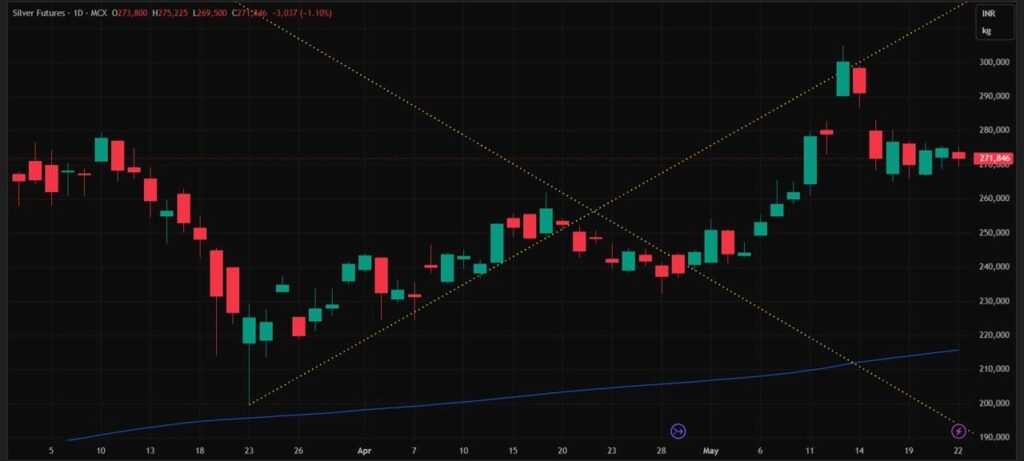
Silver’s sharp upside extension toward ₹2,95,000 to ₹3,00,000 has clearly been rejected. The large red candle from that zone marked a failed breakout at the upper extension area. Since that rejection, price has not continued lower aggressively. Instead, it has compressed around ₹2,70,000 to ₹2,76,000. That shows short-term selling pressure, but not yet a confirmed structural breakdown.
The broader breakout above the declining trendline remains intact because price is still holding above the earlier breakout and demand zone around ₹2,60,000 to ₹2,65,000. Recent candles show loss of upside momentum: lower highs after the spike, smaller bodies, and no renewed impulse buying. Buyers are stabilising price, but they are not yet reclaiming control. The pattern status is mixed. The broader breakout remains valid, but the immediate extension breakout has failed. A close below ₹2,60,000 to ₹2,65,000 would turn this into an early breakdown. A move back above ₹2,80,000 would be needed to repair short-term momentum.
Silver’s correction is also being amplified by international weakness. COMEX silver fell 1.7% over the week, twice the decline in COMEX gold. The Iran negotiations stalling and oil moving higher have not helped silver’s industrial demand narrative. The gold-silver ratio is back to around 59 to 60 from the compressed 58.5 of two weeks ago, suggesting silver’s relative outperformance is also pausing. For the Indian trade, the duty hike applies equally to silver as to gold (15% basic plus other levies), but silver’s correction has been sharper in both absolute and percentage terms. The medium-term thesis for silver remains intact, but tactical patience makes more sense now than tactical aggression.
| Key Takeaway: Silver shows a failed breakout from the ₹2,95,000 to ₹3,00,000 extension zone, but it is still consolidating above the broader breakout base. The move has shifted from bullish expansion to corrective compression, with ₹2,60,000 to ₹2,65,000 now the key zone separating a healthy pullback from an early breakdown. Position sizing matters more here than in gold given silver’s volatility. The medium-term outlook remains constructive, but the next decisive move could go either way and trade participants should plan for both scenarios. |
Special Focus | The WGC’s First Read on the Duty Hike:
The World Gold Council’s India Gold Market Update released Friday May 22 is the most important piece of structured analysis published on the May 13 duty hike to date. Several findings deserve specific attention because they shape how the trade should think about the next 6 to 12 months.
The tariff lag effect is severe. Domestic gold prices have risen only 4% to 6% since the duty hike, not the full 9 percentage point increase. This is unprecedented in magnitude. After the 2019 duty hike, discounts widened by $15 per ounce. After the 2022 hike, $24 per ounce. After this hike, $145 per ounce. The current discount to landed price is roughly 6 to 10 times larger than the historical pattern, reflecting weak demand during the inauspicious mid-May to mid-June period, ample supply from old gold exchange programmes, and front-loading by importers ahead of the duty change.
The smuggling response is statistically meaningful. The WGC’s analysis of import duty cycles from 2013 to 2026 shows a 0.52 correlation between higher duties and unofficial imports, when COVID years are excluded. After the 2013 duty hike, unofficial imports increased from approximately 10 tonnes in Q1 2013 to 70 tonnes by Q1 2014, a sevenfold increase in under a year. After the 2022 hike, unofficial imports rose from 17 tonnes in Q2 2022 to nearly 50 tonnes by late 2022 and remained elevated through 2023. After the 2024 duty cut, unofficial imports fell almost immediately to near zero. The implication for 2026 is clear: the duty hike will increase smuggled inflows, which compete with official imports and pressure margins for organised retailers.
Official imports may prove more resilient than expected. Despite the conventional wisdom that high duties suppress imports, the WGC analysis shows official imports remained relatively stable across duty regimes ranging from 6% to 15%. Quarterly averages stayed between 175 and 236 tonnes in most non-COVID periods. The correlation between duty rates and official imports is actually slightly negative at minus 0.17, indicating broader demand conditions matter more than duty levels for the volume of formal imports. April 2026 imports rose more than 80% year-on-year despite all the disruption, driven by refiner intake of gold dore around Akshaya Tritiya and likely front-loading ahead of the duty change.
Demand will moderate but not collapse. The WGC estimates combined jewellery and bar and coin demand will decline by 50 to 60 tonnes in 2026, approximately 10% lower than 2025. Importantly, investment demand (bars and coins) is more sensitive to duty changes than jewellery demand, because jewellery purchases are often requirement-driven (weddings, social occasions) while investment demand is more discretionary. This means the structural mix shift toward investment that drove headline growth in 2025 may pause or reverse. Listed jeweller share prices fell 2% to 17% in the days following the duty hike, reflecting market expectations of weaker discretionary demand.
Trade segment impact is uneven. The WGC report provides a useful segmentation. Large chain stores expect a slowdown but remain relatively resilient given inventory buffers and continued bridal demand support. Mid-sized and regional players are leaning into exchange programmes and tighter inventory cycles. Smaller retailers, already stretched by persistently high prices, are most vulnerable. The duty hike compounds an existing pressure rather than introducing a new one. For trade publications and industry bodies, the smaller retailer segment is where the next 6 months of stress will be most visible.
Gold ETFs reversed sharply. After 12 consecutive months of positive flows, Indian gold ETFs experienced outflows from May 13 to 18, largely reversing earlier gains. Cumulative holdings still rose modestly in April to 116.7 tonnes, but AUM is down 3% from January due to softer prices. ETF folio growth in April was 77,413, the lowest since September 2024. The investment substitution story that drove 2025 may face its first real test now, as physical alternatives become structurally more expensive.
Taken together, the WGC analysis suggests the duty hike will have meaningful but manageable effects on official market dynamics, while creating significant headwinds for the unorganised periphery and shifting the demand mix back toward jewellery and away from investment products. The 10% volume decline estimate is bigger than the 2019 or 2022 duty hike effects, reflecting the unprecedented 9 percentage point scale of this change.
Source: World Gold Council, India Gold Market Update: Import Tightening, published May 22, 2026. Used in line with fair industry practice with citation to the World Gold Council as source.
Watch in the Days Ahead:
- RBI MPC meeting (June 6): Markets are now actively pricing the possibility of a rate hike if rupee pressure persists. A hike would be sharply rupee-supportive but bearish for equities and gold ETF flows. A hold despite continued rupee weakness would be the opposite signal. The reaction function of the RBI in the days leading up to the meeting will tell us everything about how policy is thinking about the gold-rupee-balance of payments triangle.
- Domestic price normalisation: With domestic prices trading at a record $145 to $150 per ounce discount to the landed price, the question is when and how the gap closes. Either international prices fall (compressing the gap downward) or domestic prices rise as demand normalises and exchange supply tapers off. The latter is the more likely path and would mean MCX prices have asymmetric upside from here.
- Iran-US negotiations: Iran’s directive to keep enriched uranium domestic has hardened positions. Oil rose 2% on that news. Continued stalemate keeps oil elevated, rupee under pressure, and the precious metals trade supported. A genuine breakthrough would be bearish for both metals in dollar terms but supportive for the rupee.
- Smuggling indicators: Watch for early data on unofficial imports, customs seizures, and reports of arbitrage activity. The WGC’s historical analysis suggests measurable smuggling response within 60 to 90 days of a major duty hike. Industry intelligence sources and customs press releases will be the early warning system.
- MCX key levels: Gold: ₹1,54,000 to ₹1,56,000 must hold to keep the breakout intact, ₹1,62,000 to ₹1,64,000 supply must clear for continuation, ₹1,68,000 is the next major target. Silver: ₹2,60,000 to ₹2,65,000 is the structural line separating healthy pullback from early breakdown, ₹2,80,000 reclaim needed for short-term momentum repair.
Disclaimer: This article is for informational purposes only and does not constitute investment or trading advice. All prices are futures closing prices, MCX in INR, COMEX in USD. The Special Focus section draws on data from the World Gold Council India Gold Market Update published May 22, 2026, used in line with fair industry practice with citation to the World Gold Council as source. Past performance is not indicative of future results.
Authored by Dhawal Chotai