


Gold cleared its descending trendline and silver reclaimed its 200-day average as cooling US data reopened the case for a Fed hold. The long end of the curve, still near multi-year highs, has not yet agreed.
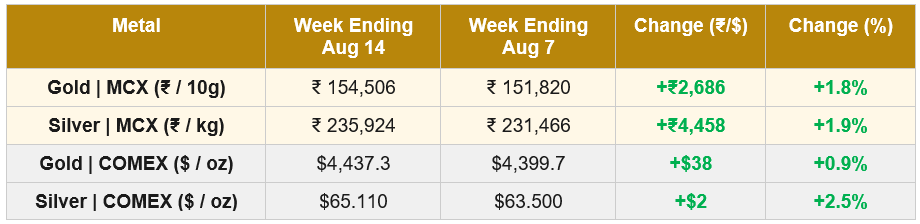
Macro Snapshot: US data through the week ending August 14 softened the case for another Federal Reserve rate increase. July consumer prices (August 12) rose 0.1 percent on the month and 3.4 percent on the year, a tenth below June, with core at 2.5 percent. The July Producer Price Index (August 13) came in flat against an expected 0.2 percent gain, its annual pace cooling to 4.7 percent from 5.5 percent. Friday sealed the shift: retail sales fell 0.6 percent, the steepest drop since May 2025, and the University of Michigan’s preliminary sentiment reading sank to 51.0 from 55.2.
That sequence reset rate expectations: CME FedWatch moved from better-than-even odds of a September hike in late July to roughly 69 percent odds by Friday that Warsh’s Federal Open Market Committee holds the 3.50 to 3.75 percent range on September 16. The July 29 meeting had ended 9-to-3 to hold, three dissents favouring a hike, so that minority stays live even as growth cools. The long end did not follow: the 10-year yield finished Friday near 4.68 percent, off a 19-month high near 4.75 percent on Tuesday, while the 30-year held near 5.26 percent, close to a 19-year high, kept firm by Warsh’s signal that a hike may not be his preferred tool and by rising inflation expectations (Michigan’s one-year gauge at 4.3 percent, a fifth month above 4 percent).
Energy stayed the engine beneath the inflation anxiety: crude rose more than 5 percent on the week as the US signalled its naval blockade of Iranian ports could continue indefinitely and Treasury Secretary Scott Bessent warned of unprecedented measures to isolate Iran’s economy. Brent settled Friday up 1.7 percent at $88.52 and WTI up 1.4 percent at $82.40, with the International Energy Agency flagging the widest global supply deficit in five years. The February US and Israeli strikes on Iran, and the partial Strait of Hormuz closure, keep a risk premium feeding both inflation and safe-haven demand.
The rupee, the swing factor for Indian prices, traded near 95.4 to the dollar, pressured mid-week by firm crude and foreign portfolio outflows, and cushioned by near-daily RBI intervention, before firming three paise to close Friday at 95.42, modestly weaker than the prior Friday’s 95.14. That slippage helped MCX gold’s 1.8 percent gain outpace COMEX gold’s 0.9 percent; silver diverged, its 2.5 percent COMEX advance running ahead of the 1.9 percent MCX move, a reminder the local-to-global spread does not always favour the domestic contract.
Gold-specific drivers: The official sector remains the structural floor under gold. The World Gold Council’s July 30 Gold Demand Trends report put second-quarter central-bank buying at a net 289 tonnes, a quarterly record and 62 percent above a year earlier, led by Poland and China, and noted gold has overtaken US Treasuries as the world’s largest reserve asset. In India, the May 13 duty increase to 15 percent (a total levy near 18.45 percent with IGST) still weighs on discretionary demand, though the August-to-December festival and wedding season is beginning to draw buyers back.
Silver-specific drivers: Silver’s case rests on a supply shortfall that will not close quickly: the Silver Institute projects a 46.3 million ounce deficit in 2026, the sixth straight annual shortfall, against a supply base where roughly 70 percent of the metal is a by-product of copper, zinc, lead and gold mining and so responds slowly to price. Industrial demand, led by solar photovoltaics, holds near record levels even as high prices trim usage, an erosion offset by rising retail coin and bar buying. The gold-silver ratio eased from about 69 to about 68 across the week as silver outran gold, leaving it historically cheap against gold despite the recovery.
Gold | MCX GOLD1!
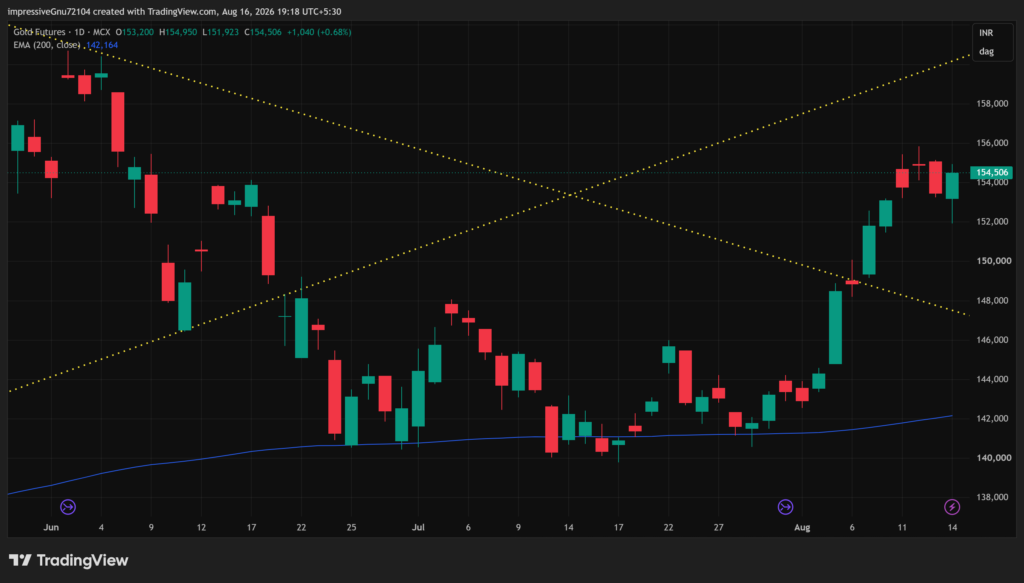
Gold has broken decisively out of the June to July decline, building higher highs and higher lows on progressively stronger candles. At ₹154,506, price sits well above the 200-day EMA at ₹142,164, and the descending trendline that governed the summer slide has broken with conviction: price accelerated away from it, cleared ₹150,000, and pushed toward ₹155,000 to ₹156,000, evidence of acceptance rather than a one-session spike. The advance through ₹152,000 has carried larger directional candles and little downside overlap, closer to an impulsive recovery than a slow corrective bounce. The next hurdle is ₹155,500 to ₹156,000, where the August swing high and the June reaction zone layer supply; Friday’s candle reached ₹154,950 and closed at ₹154,506, so buyers held the session, though acceptance above that ceiling is not yet proven.
The cleaner signal would be a daily close through roughly ₹156,000 with follow-through, or a pullback to ₹152,500 to ₹153,500 that finds buyers, turning former resistance into support. A move below ₹152,000 would weaken the breakout without ending the recovery; a deeper break below ₹149,000 to ₹150,000 would return price to the zone the advance accelerated from, the more meaningful deterioration.
| Key Takeaway: The reversal thesis has strengthened: the trendline break has follow-through, and price is consolidating close to its highs, though ₹155,500 to ₹156,000 must still convert from resistance into accepted trade before the next leg is confirmed. The rupee’s softness continues to lift the MCX contract slightly more than its dollar equivalent, a cushion that has quietly widened the local gain. |
Silver | MCX SILVER1!
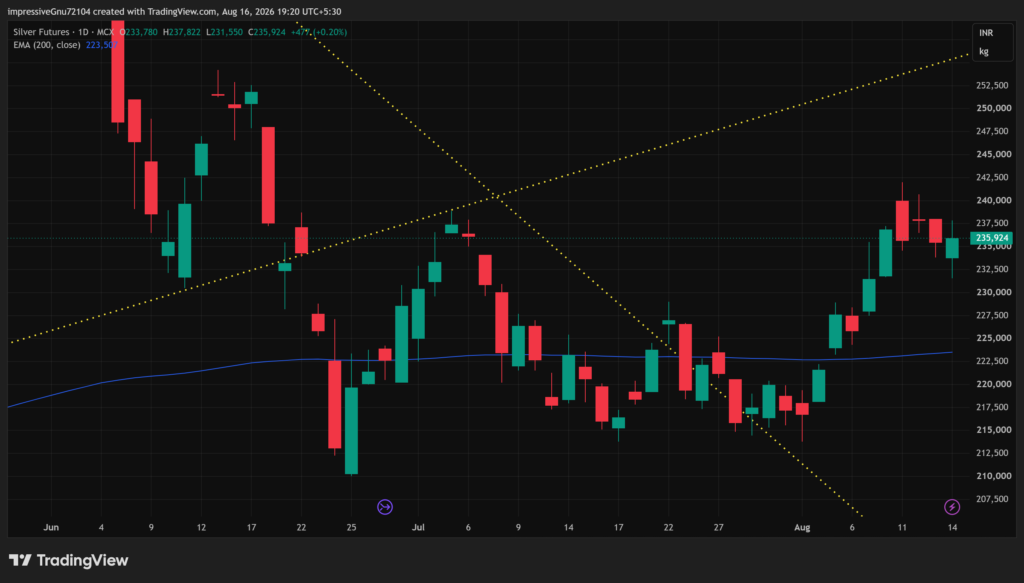
Silver’s transition has been more volatile. After spending much of July below its 200-day EMA, price based around ₹215,000 to ₹220,000, reclaimed the average at ₹223,507, and extended toward ₹240,000, staying above the EMA while pushing higher rather than briefly crossing it, which gives the reclaim real weight. The descending trendline that capped the summer decline has likewise broken, with silver trading away from it for several sessions rather than slipping back under. The advance from the late-July base near ₹217,000 through ₹225,000, ₹230,000, and ₹237,000 has carried strong candles and limited pullback, expanding momentum rather than a simple oversold bounce. The unresolved question is ₹239,000 to ₹242,000: silver reached ₹237,822 on Friday and closed at ₹235,924, and the upper wick shows reaction and supply, not a confirmed rejection.
Acceptance above roughly ₹240,000 to ₹242,000 would complete another structural step and open ₹247,000 to ₹250,000 as the next reaction area. Sustained trade below ₹233,000 to ₹234,000 would suggest the advance is losing momentum, and a move back through ₹227,000 to ₹228,000 would be more damaging, undermining the sequence of higher lows built in the recovery. The 200-day EMA near ₹223,500 is now the anchor: while price holds above it, the medium-term improvement survives a normal corrective phase.
| Key Takeaway: Silver has completed more of the structural recovery than gold, with a trendline break and a sustained 200-day EMA reclaim, but its overhead supply near ₹239,000 to ₹242,000 is more visible, and the latest candle is a reaction from resistance, not a breakout. The next several closes should decide whether that zone converts. Silver’s weekly gain lagged its COMEX counterpart, the reverse of the usual rupee amplification, leaving the domestic contract room to catch up if the global move extends. |
Watch in the Days Ahead:
- Jackson Hole and Warsh’s first keynote (August 27 to 29): The last major venue to shape rate expectations before the September 16 FOMC. A hawkish tone would pressure both metals; acknowledgement of cooling growth would support the recovery.
- FOMC minutes (August 19): Should show how close the committee sits to a hike and how the three July dissenters framed their case, a direct input into September pricing.
- PCE inflation and GDP revision (August 26): Tests whether the soft CPI and PPI readings carry through. A firmer core PCE would revive hike odds and cap both metals; a softer print reinforces the hold case.
- Oil and the Strait of Hormuz: A credible move toward reopening the strait would ease the energy-driven inflation premium and the safe-haven bid together; continued blockade or tanker disruption keeps both alive.
- Gold levels: A daily close above ₹156,000 confirms continuation; a hold of ₹152,500 to ₹153,500 on a pullback also supports it. A break below ₹149,000 to ₹150,000 is the bearish signal.
- Silver levels: Acceptance above ₹240,000 to ₹242,000 opens ₹247,000 to ₹250,000. Failure to hold ₹233,000 to ₹234,000, and especially ₹227,000 to ₹228,000, warns the recovery is stalling.
Disclaimer: This column is for informational purposes only and does not constitute investment advice. Gold and silver prices are volatile, and past performance is not indicative of future results. Readers should conduct their own research or consult a licensed financial adviser before making any investment decision.
Authored by Dhawal Chotai