


Macro Snapshot: Federal Reserve raised its target range by 25 basis points to 3.75% to 4.00% on 16 September, a unanimous 12-0 vote and the first increase since July 2023. Updated projections showed 16 of 18 participants expecting at least one further hike before the end of 2026, put the median path at 4.1% for both 2026 and 2027, and pencilled headline PCE inflation at 3.7% for 2026 with no return to the 2% target until 2029.
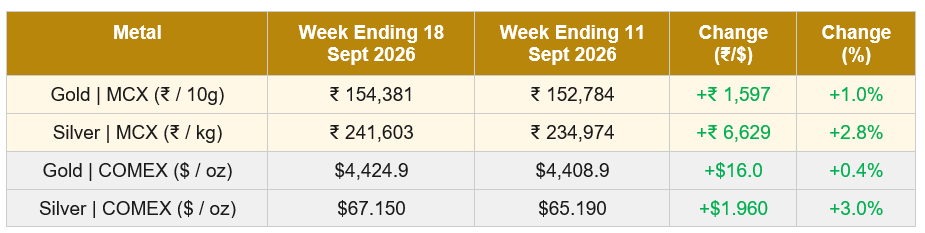
Bond and currency markets took the message at face value. The 10-year Treasury yield topped 5.04% ahead of the decision, its highest since 2007, and closed 18 September at 5.004%, with the 30-year at 5.336%. The dollar index ended at 100.215, firmer by roughly 1.1% across the five sessions. Both metals rose through all of it.
Crude, not the Fed, set the tone. Drone strikes on Saudi Arabia’s East-West pipeline on 10 September forced the seven million barrel per day line shut a day later and lifted Brent near $108 by 14 September. Prices then fell three consecutive sessions once Aramco signalled that half the capacity could return within days and the full line within roughly six weeks. Brent settled at $103.87 on 18 September and WTI at $100.30, leaving Brent lower by about 1.2% on the week and draining the inflation premium that had been pressing on bullion. Gold posted its first weekly gain in four.
Indian holders felt that sequence in reverse. The rupee closed 11 September at 95.57, then weakened for six straight sessions to 95.88 on 15 September and traded near 96.11 on 16 September, a seven-week low. Relief arrived late. Following a settle at 95.89 on 17 September, the currency firmed toward 95.7 on Friday as crude eased, the Reserve Bank was suspected of intervening and traders positioned for inflows into the National Stock Exchange’s $2.3 billion offering. Foreign portfolio investors pulled ₹20,974 crore from Indian equities through 18 September, taking the 2026 equity outflow to ₹2.45 lakh crore against ₹1.66 lakh crore for the whole of 2025. CME FedWatch priced the odds of an October increase at 49% immediately after Kevin Warsh’s press conference, against 40% that morning. The Bank of Japan lifted its own rate to a 31-year high of 1.25% on 18 September.
Gold-specific drivers: India’s domestic discount had widened all quarter, from an average of $34 per ounce in July to $51 in August and $78 as of 11 September, leaving local prices close to 2% below landed cost. Old-gold exchange and unofficial supply had met tepid jewellery demand, according to a World Gold Council update published 17 September. Dealer quotes narrowed to discounts of up to $60 per ounce during the reporting week, against up to $75 previously, which is why MCX gold outpaced COMEX by more than the currency alone explains. Gold imports had already fallen to $2.3 billion in August, down 45% month on month, while Indian gold ETF holdings rose to 121.3 tonnes.
Silver-specific drivers: Silver’s 3.0% COMEX gain against gold’s 0.4% pulled the international ratio from 67.6 to 65.9, extending a rotation that the Silver Institute’s projected 46.3 million ounce deficit for 2026, on flat mine supply and by-product dependence above 70%, continues to underwrite. Domestic arithmetic ran the other way. MCX silver gained 2.8% while COMEX gained 3.0%, and a weaker rupee should have widened that gap rather than inverted it, which means India’s silver basis contracted by roughly three quarters of a percentage point. Indian holders did not keep what the currency handed them.
Gold | MCX GOLD1!
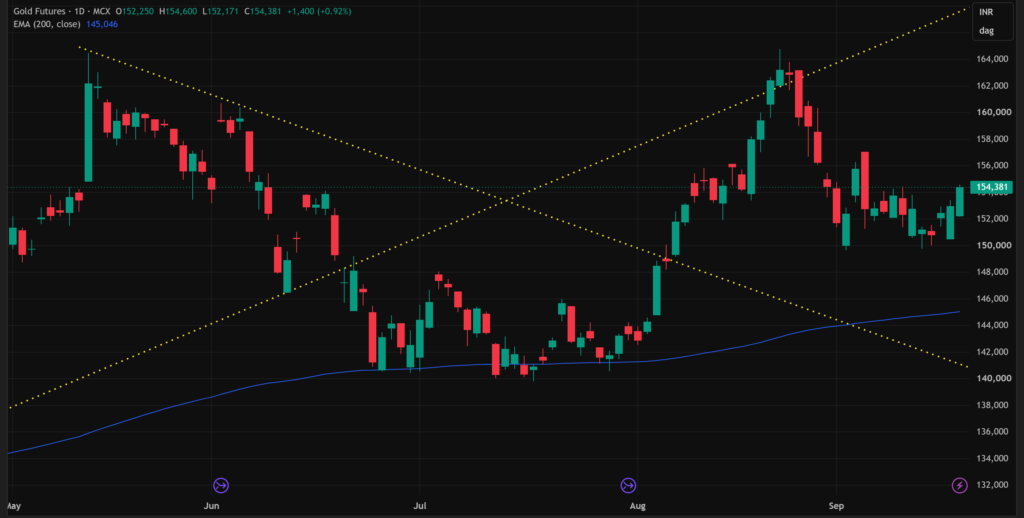
closed 18 September at ₹154,381, roughly 6.4% above a 200-day exponential moving average at ₹145,046, which keeps the longer trend intact even though the correction that began near ₹164,000 to ₹165,000 remains unresolved. The more telling feature of September has been the loss of downside momentum around ₹150,000 to ₹151,000. Following the sharp decline from the August peak, price has oscillated rather than continued to make lower lows, and repeated reactions near ₹150,500 to ₹152,000 point to buyers defending that shelf.
The latest session supports the reading. Gold opened at ₹152,250, dipped only marginally to ₹152,171, advanced to ₹154,600 and closed at ₹154,381, very near the day’s high and without meaningful upper-wick rejection, which suggests sellers did not regain control after the intraday advance. Location matters more than the candle, though, and price is now pressing into ₹154,500 to ₹156,000, the zone where several September reactions occurred.
Framing the structure as a range of roughly ₹150,500 to ₹156,000 remains the most defensible interpretation, with demand showing up near the lower boundary and supply near the upper one, and neither yet giving way on a closing basis. The descending trendline from the May and June decline broke long ago and now sits well below the market, while the rising line remains far above it, so the horizontal levels carry the information. Confirmation sits at ₹155,000 to ₹156,000; acceptance above would open ₹158,000 to ₹160,000 and then the prior high near ₹163,000 to ₹165,000. First support stays ₹152,000 to ₹153,000, with a decisive break under ₹150,000 to ₹151,000 exposing ₹147,000 to ₹149,000.
| Key Takeaway: Recovery is constructive but still contained. A few sessions of consolidation between ₹152,000 and ₹155,000 followed by a clean break would be better structural evidence than another isolated one-day surge. For Indian buyers, the decision point at ₹155,000 to ₹156,000 arrives just as the domestic discount narrows, so landed cost is rising faster than the international screen suggests. |
Silver | MCX SILVER1!
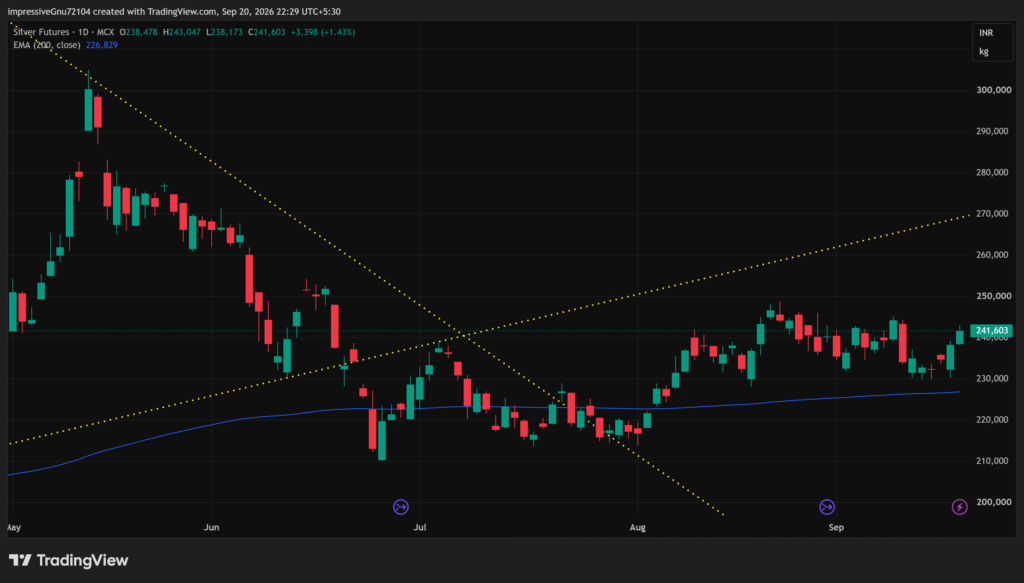
Silver closed 18 September at ₹241,603, roughly 6.5% above a 200-day exponential moving average at ₹226,829, so the medium-term structure remains positive despite weeks of sideways trade. Repeated defence of ₹230,000 to ₹233,000 has established that band as the main near-term demand area, with several tests failing to produce sustained acceptance beneath it. At the other end, ₹244,000 to ₹248,000 has attracted supply on every approach, and the repeated failure to hold above the upper region is the reason to withhold a breakout label.
The latest candle is nevertheless encouraging. Silver opened at ₹238,478, traded as low as ₹238,173, rallied to ₹243,047 and closed at ₹241,603, comfortably above the open and near the upper end of its range. Some upper wick shows sellers appearing above ₹243,000, although not enough to constitute a convincing rejection.
What the chart describes is a range within an uptrend: a rising 200-day average and a higher base around ₹215,000 to ₹225,000 beneath price action contained between ₹230,000 to ₹233,000 and ₹244,000 to ₹248,000. The old descending trendline has been decisively broken and the rising one sits well above the market, so horizontal reaction zones again carry the weight. The immediate test is ₹243,000 to ₹245,000, and a daily close through roughly ₹245,000 with follow-through would be a meaningful structural development, opening ₹248,000 to ₹250,000. Initial support is ₹237,000 to ₹239,000, with ₹232,000 to ₹234,000 the level that matters and ₹228,000 to ₹230,000 exposed beneath it.
| Key Takeaway: Momentum has returned from the lower end of the range and close quality is good, yet ₹243,000 to ₹248,000 remains the deciding supply band. Indian stockists should weigh a second point: silver’s domestic basis contracted while COMEX ran, so an international breakout may translate into less on the MCX invoice than the headline percentage implies. |
Watch in the Days Ahead:
- Saudi pipeline repair: Aramco has signalled half of the East-West line within days and full capacity within roughly six weeks. Faster restoration pulls Brent under $100 and takes more inflation premium out of bullion, while a fresh strike reverses both channels at once.
- The 28 October FOMC: CME FedWatch had the odds of another increase near half immediately after the September decision, with 87% odds of at least one more hike in 2026. Repricing meaningfully above that pressures both metals through real yields.
- Rupee and flows: Subscription for the National Stock Exchange offering closes 21 September. Sizeable foreign demand would firm the rupee and cap MCX gains, while continued equity selling against Brent above $100 reopens the path toward 96.
- Levels: Gold needs a daily close above ₹156,000 to convert range into trend, with ₹150,500 the floor. Silver’s line is ₹245,000 on the upside and ₹232,000 on the downside.
Disclaimer: The column is for information and education only and is not investment advice, a recommendation, or an offer to buy or sell any security or commodity. Prices are as reported by MCX and COMEX. Readers should consult a registered adviser before acting.
Authored by Dhawal Chotai