


Macro Snapshot: The selling that pushed both metals lower in the week ending 25 September came from the American bond market rather than from any bullion-specific news. S&P Global’s flash survey on 23 September put its composite output index at 58.4, the strongest reading since July 2021, with services at 58.7 and manufacturing at 56.7. On the same morning, Federal Reserve Governor Michael Barr said further policy adjustments were likely to be needed to return inflation to target. A poorly received five-year note auction compounded the damage, and the 10-year Treasury yield rose more than 13 basis points that day, its largest single-session move in nearly 18 months.

Yields held their ground into Friday. The 10-year closed 25 September at 5.17%, roughly 16 basis points higher on the week and near its highest level since 2007, while the 30-year finished at 5.49% after reaching its highest since 2004 on 24 September. CME FedWatch priced a 73% chance of a hike at the 27 to 28 October meeting on 23 September, against roughly even odds after the 16 September decision, and the probability was still near 70% at the close. The dollar index climbed to around 101, a two-month high.
Crude sent two contradictory signals. West Texas Intermediate settled at $92.41 on 25 September, down 7.9% on the week, as reports of a phased US and Iran arrangement to reopen the Strait of Hormuz and talk of a US diesel export ban weighed on American barrels. Brent, which tracks India’s import costs far more closely than WTI, settled at $104.32 and finished 0.4% higher, having touched $108 intraday on 24 September, when Houthi missiles targeted Saudi Arabia and an adviser to Iran’s Supreme Leader warned the war could reach the Indian Ocean. The gap between the two blew out from about $3.60 to roughly $12, its widest since May.
Indian holders got only a sliver of the relief that cheaper American crude handed US inflation watchers. The rupee, which closed 18 September at 95.96, firmed to about 95.6 by 22 September before sliding to 95.99 on 24 September, when Brent jumped and foreign institutions sold ₹5,027 crore of Indian equities in a single session. Suspected Reserve Bank intervention then lifted it to a provisional 95.80 on Friday. A rupee roughly 0.2% firmer on the week should have made MCX losses slightly deeper than COMEX’s. Instead MCX gold fell 2.27% against 2.34% abroad and MCX silver 2.9% against 3.5%, so the domestic basis firmed modestly for gold and clearly for silver just as prices reached their September floors.
Gold-specific drivers: Retail buying now enters its quietest fortnight of the calendar. Pitru Paksha, a 16-lunar-day period in which many families avoid buying gold, is formally observed from 27 September according to several Hindu calendars, and China’s week-long National Day holiday begins on 1 October. Prithviraj Kothari, president of the India Bullion and Jewellers Association, described the Pitru Paksha slowdown on 18 September as generally temporary, with demand expected to return through Navratri, Dhanteras and the wedding season. The starting point is weak, with the World Gold Council’s India update of 17 September putting the domestic discount at $78 per ounce as of 11 September, nearly 2% below landed cost. A firmer basis in the week ending 25 September is the first hint that the trade has begun restocking ahead of that return.
Silver-specific drivers: Silver fell harder than gold abroad, down 3.5% on COMEX, and the international gold-silver ratio widened from 65.9 to 66.7. Most of that gap opened on 23 September, the day of the PMI surprise and Barr’s remarks, when silver fell more than twice as far as gold in percentage terms, the higher beta the metal tends to show when yields jump. India’s firmer silver basis is therefore the more telling domestic signal, because it suggests local buyers absorbed part of a decline that ran deeper abroad than at home.
Gold | MCX GOLD1!
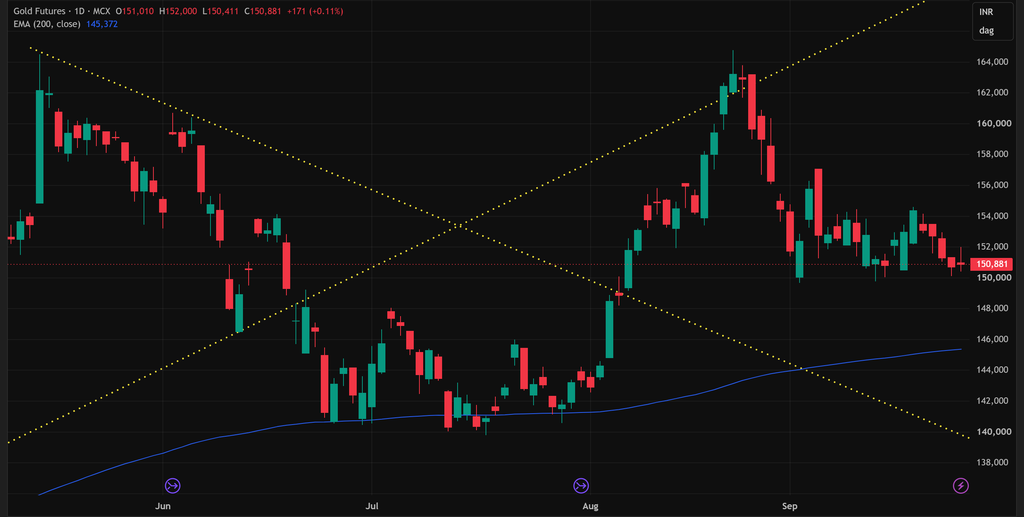
Gold closed 25 September at ₹150,881, about 3.8% above a rising 200-day exponential moving average at ₹145,372, so the longer trend remains intact, but the week erased the entire push toward ₹154,500 that ended the prior week and returned price to the bottom of its September range. The structure since early September carries a clear asymmetry: rally highs have stepped down from roughly ₹157,000 in the first week of the month to about ₹154,500 to ₹154,800 on later attempts, while the lows have held flat around ₹150,000 to ₹150,500. Descending highs against a horizontal floor describe compression that is leaning on support rather than on resistance.
Friday’s candle captures that balance. Gold opened at ₹151,010, rallied to ₹152,000, slipped to ₹150,411 and closed at ₹150,881, a narrow session whose upper wick shows sellers still active above ₹151,500 even as buyers again refused to surrender the floor on a closing basis. No September session has closed meaningfully below ₹150,000, which keeps the correct label at consolidation rather than breakdown, though each successive visit to the same shelf tells the market something about how much demand is left on it.
Horizontal levels now carry the read. The descending trendline from the May and June decline broke in early August and the rising line sits well above price, so neither frames the immediate decision. A daily close below ₹150,000 with follow-through would be an early breakdown, exposing ₹147,000 to ₹149,000, where the early August breakout began, and then the 200-day average near ₹145,000. On the upside, a close back above ₹152,000 is the minimum requirement before ₹154,500 to ₹155,000 becomes a realistic test again.
| Key Takeaway: Gold is still consolidating, but the compression now leans toward the floor. Indian buyers should treat ₹150,000 as the line separating a range from a correction: a hold through Pitru Paksha, without the usual retail bid, would be stronger evidence than any rally, while a break would most likely meet festive restocking at lower prices. |
Silver | MCX SILVER1!

Silver closed 25 September at ₹234,696, about 3.3% above its 200-day exponential moving average at ₹227,307, a thinner cushion above the long-term trend than gold enjoys. The metal has traded between roughly ₹229,500 and ₹248,500 since mid-August, with the upper half of that range failing progressively. Swing highs stepped down from about ₹248,500 in August to roughly ₹245,000 in mid-September and ₹243,000 on 18 September, while the lows have held near ₹230,000 to ₹232,000.
Friday produced silver’s firmest session of the week. Silver opened at ₹233,736, dipped to ₹232,400, rallied to ₹237,200 and closed at ₹234,696, a 0.5% daily gain, although the retreat from the high left a visible upper wick and the close sat mid-range. The dip stopped above the ₹230,000 to ₹232,000 band once more, which is the reaction a defended floor should produce, but a reaction becomes a reversal only when price reclaims higher ground with some persistence.
As with gold, the descending line from the May highs broke in early August and the rising trendline is far overhead, so horizontal levels decide the read. Immediate resistance is ₹237,000 to ₹238,000, where Friday’s rally stalled, with ₹241,000 to ₹243,000 above it. A daily close below ₹229,500 would mark an early breakdown, bringing the 200-day average near ₹227,000 into play and then the ₹220,000 to ₹224,000 area that anchored the early August advance.
| Key Takeaway: Silver is consolidating above a defended floor, and Friday’s bounce is the first sign of buyers at the lower boundary. A domestic basis that firmed by roughly 0.8 percentage points while COMEX fell suggests Indian demand absorbed part of the decline; stockists should watch whether that support survives the Pitru Paksha lull, because ₹230,000 sits closer to the 200-day average than gold’s floor does. |
Watch in the Days Ahead
- US data run: Conference Board confidence, the August PCE inflation report, the ISM manufacturing survey on 1 October and payrolls on 2 October decide whether near 70% October hike odds survive. Soft prints would ease yields and lift both metals off their floors; hot ones test them directly.
- Hormuz talks: A phased US and Iran deal would pull Brent toward WTI and give the rupee genuine relief. A collapse would put the $108 Brent high of 24 September back in play and press the currency against 96.
- Seasonal demand gap: With retail quiet through Pitru Paksha, dealer discounts will show whether wholesale restocking ahead of Navratri arrives in time to defend the domestic floor.
- Levels: Gold ₹150,000 support and ₹152,000 resistance; silver ₹229,500 support and ₹237,000 to ₹238,000 resistance.
Disclaimer: This column is for information only and does not constitute investment advice. Prices and levels cited are based on data available at the time of writing. Readers should consult a qualified advisor before making trading or investment decisions.
Authored by Dhawal chotai