


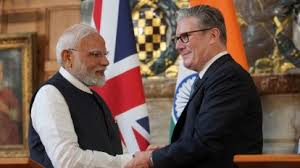
Mumbai: India and the United Kingdom formalized a landmark Free Trade Agreement (FTA) on Thursday after years of negotiations. Officially titled the Comprehensive Economic and Trade Agreement (CETA), the deal is designed to significantly enhance bilateral trade and investment, with both nations aiming to double trade volume from the current $56 billion to over $100 billion by 2030.
The CETA is widely appreciated as the ‘Game-Changer Move’ for India’s Gems & Jewellery (G&J) Sector by the industry leaders.
“This landmark accord unlocks exciting new opportunities for the gem and jewellery sector. Currently, exports to the UK stand at USD 941 million; with the duty concessions in place, this figure is poised to surge to USD 2.5 billion within the next three years, elevating overall bilateral trade in our sector to an estimated USD 7 billion. What is particularly encouraging is that recent FTAs—including this one—are being forged with key consumer markets across diverse sectors. The GJEPC has proactively collaborated with the Government to ensure that our industry receives the strategic focus and priority it truly deserves,” says Mr. Kirit Bhansali, Chairman of India’s Gem & Jewellery Export Promotion Council (GJEPC).
The agreement, which received approval from India’s Union Cabinet earlier in the week, was signed at the UK Prime Minister’s official country residence, with Prime Minister Mr. Narendra Modi and British Prime Minister Mr. Keir Starmer in attendance.
Under the terms of CETA, India will progressively lower import tariffs on major UK exports such as Scotch whisky, gin, and automobiles. In exchange, India will secure zero-duty access for a range of labour-intensive goods—including textiles, leather, and footwear—offering a major boost to these sectors through expanded access to the UK market.
India’s total G&J exports to the UK are valued at $941 million, with $400 million coming from jewellery. The FTA opens up a huge market as the UK imports approximately $3 billion worth of jewellery annually.
Tariff relaxations under the FTA are projected to double India’s gems and Jewellery exports to the UK within the next 2-3 years. The Comprehensive Economic and Trade Agreement (CETA) between India and the United Kingdom, though still under negotiation (as of mid-2025), has the potential to be a game-changer for India’s gems and jewellery (G&J) sector. Here’s a breakdown of how and why:
CETA with the UK: What It Means:
While the original CETA was an EU–Canada agreement, in this context, you may be referring to the proposed India–UK Free Trade Agreement (FTA), sometimes informally referred to as a CETA-style deal. The key goals are:
- Lowering import/export duties
- Improving market access
- Streamlining standards and customs
Why It’s a Game Changer for India’s Gems & Jewellery Sector:
1. Duty-Free Access to a Major Market
- Currently, UK imposes import duties (ranging from 2–5%) on Indian diamond jewellery and gold ornaments.
- An FTA or CETA-style deal could eliminate these duties, making Indian products more competitively priced.
2. Expanded Market Reach:
- The UK is among the top 5 export destinations for Indian gems and jewellery.
- Post-Brexit, the UK is seeking bilateral partnerships — India stands to gain preferential access over other Asian competitors.
3. Boost to Diamond and Gold Exports:
- India is a global hub for diamond polishing and jewellery manufacturing.
- With zero-duty or reduced tariffs, high-value exports like natural diamonds, gold jewellery, and platinum products can increase significantly.
4. Level Playing Field Against Lab-Grown Competitors:
- The price competitiveness given by tariff removal could help natural diamond exporters regain share lost to lab-grown diamond suppliers, particularly in cost-sensitive segments.
5. Employment and MSME Boost:
- India’s G&J sector employs over 5 million people, largely in MSMEs.
- Increased export demand could stimulate domestic production, generate jobs, and drive investments in technology and design.
Strategic Opportunities:
| Area | Potential Impact |
|---|---|
| Export Growth | 10–15% rise in UK-bound exports in 1–2 years post-FTA |
| Brand India Push | “Made in India” jewellery gets a stronger presence in Europe |
| Value Addition | Encourages India to export finished goods rather than raw diamonds |
| Supply Chain Integration | Better integration with UK’s luxury retail, design houses, and distribution networks |
Key Support Needed:
To maximize this opportunity, India’s G&J sector must:
- Invest in branding and storytelling — especially for natural diamonds
- Enhance design innovation to appeal to European tastes
- Ensure traceability and ethical sourcing to meet UK consumer and regulatory expectations
- Simplify domestic compliance and logistics for smoother exports
In Conclusion:
The India–UK CETA-style FTA could:
✅ Boost exports
✅ Strengthen India’s position as a global jewellery powerhouse
✅ Help natural diamond players combat the rise of lab-grown diamonds
✅ Empower MSMEs and artisans
It’s not just a trade deal — it’s a strategic pivot for the future of India’s jewellery export economy.
Posted by Suresh Chotai