


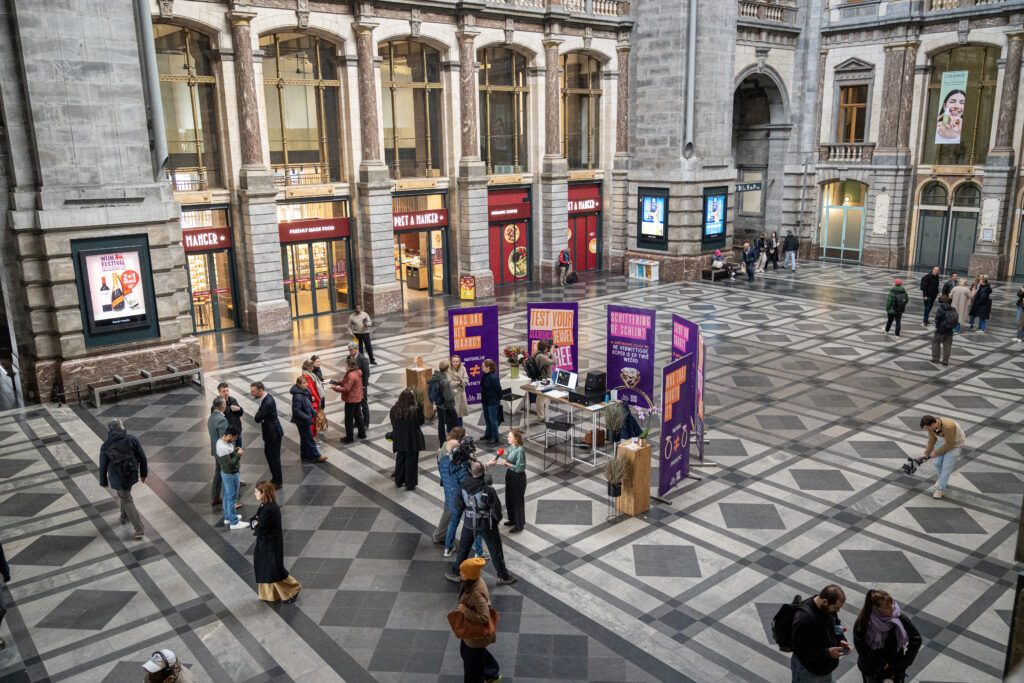
Antwerp: During a public event today at Antwerpen-Centraal railway station, the diamond industry body Antwerp World Diamond Centre (AWDC) raised awareness among passers-by about the risk of deception by jewelers when purchasing diamond jewelry.
A lack of consumer knowledge about the difference between natural and synthetic diamonds makes them vulnerable to malpractice. During the initiative, passers-by could have their diamond jewelry scanned free of charge to discover whether it contained natural or synthetic diamonds. Belgium’s Minister of Employment and Economy David Clarinval is also advocating greater transparency and is examining whether the term “diamond” could in the future be reserved exclusively for natural diamonds.
Lack of consumer knowledge:
For many buyers, purchasing a diamond jewel is both an emotional and a significant financial decision. Unfortunately, things sometimes go wrong due to a lack of consumer knowledge and because jewelers do not always comply with their obligation to inform customers. Karen Rentmeesters, CEO of Antwerp World Diamond Centre, explains, “Natural and synthetic diamonds look identical to the naked eye, but they differ greatly in value. A natural diamond worth 8900 USD will have a synthetic alternative worth about 100 USD. Anyone who does not know the difference therefore risks buying a jewel with synthetic diamonds while paying the price of a natural diamond jewel.”
According to AWDC, correct information is therefore crucial. “Consumers should know that they can, for example, ask for a diamond certificate clearly stating whether the stones are natural or synthetic. With this initiative, we want to raise awareness about that risk and give people the right tips to buy a diamond jewel with confidence,” Rentmeesters adds.
Information obligation for jewelers:
Providing correct information is not only the responsibility of the buyer. Since 1 May 2023, jewelers in Belgium have been legally required to inform customers, through a document, about the characteristics of the diamonds they sell, including the weight and the nature of the stone (natural or synthetic).
“But in practice we see that this obligation is often not respected,” says Karen Rentmeesters. “As a result, consumers remain vulnerable and their lack of knowledge can be exploited.”
Minister of Employment and Economy David Clarinval acknowledges the issue: “Whether it concerns products or services, as Minister of Economy I stand for transparency and fair competition. Anyone buying a diamond must know exactly what they are purchasing. Today, however, there is still too much confusion in the diamond sector. Synthetic diamonds are almost impossible to distinguish from natural diamonds with the naked eye and must therefore be clearly presented as such. That is why in 2023 the government adopted a Royal Decree to better protect consumers when buying diamonds. Sellers are required to provide a standard document with every purchase, listing the key characteristics of the diamond and clearly stating whether it is a natural or synthetic diamond.”
The minister also wants to go one step further. “I want to examine whether the term ‘diamond’ can be reserved exclusively for natural diamonds. Synthetic diamonds would then be marketed only under the label ‘synthetic’. This is a matter of transparency for consumers and fairness towards our diamond sector,” he concludes.
Because the current information obligation only applies to the physical sale of jewelry, AWDC is also calling for the legislation to be extended to online shops and advertising. “Two important additional steps to better protect consumers from deception,” Rentmeesters says.
Free scan and jewelry certificate at HRD Antwerp:
During the public event, passers-by could have their diamond jewelry scanned free of charge to determine whether it contained natural or synthetic diamonds. A diamond expert explained the result on site. Owners then received a statement with the scan result and the option to obtain an official, full jewelry certificate for any jewel from the Antwerp diamond laboratory HRD Antwerp at a discounted rate of €25.
Visitors also received a practical buying guide with tips on how to purchase a diamond jewel with confidence.
The event took place on Tuesday, 10 March, from 10 a.m. to 5 p.m. in the entrance hall of Antwerpen-Centraal railway station.
6 Tips when buying a diamond jewel:
- Always ask what type of diamond it is. Natural or synthetic?
- Ask for an official diamond certificate and check its contents. A certificate mentions, among other things: whether the diamond is natural or synthetic, the 4 Cs (carat, color, cut and clarity), and a unique certificate number.
- Trust only recognized diamond laboratories. A self-written certificate from a jeweler is not valid. Reliable certificates come from reputable international labs such as HRD Antwerp, Gemological Institute of America or International Gemological Institute.
- In doubt? Have your diamond checked.At Checkpoint Diamond you can have your diamond tested free of charge to determine whether it is natural or synthetic.
- Buy from trustworthy jewelers. Jewelers with the Antwerp’s Most Brilliant label meet strict quality and transparency requirements. https://visit.antwerpen.be/antwerps-most-brilliant
- Were you misled? Do not let it go. File a report with the local police or via the official Belgian reporting platform: meldpunt.belgie.be.