


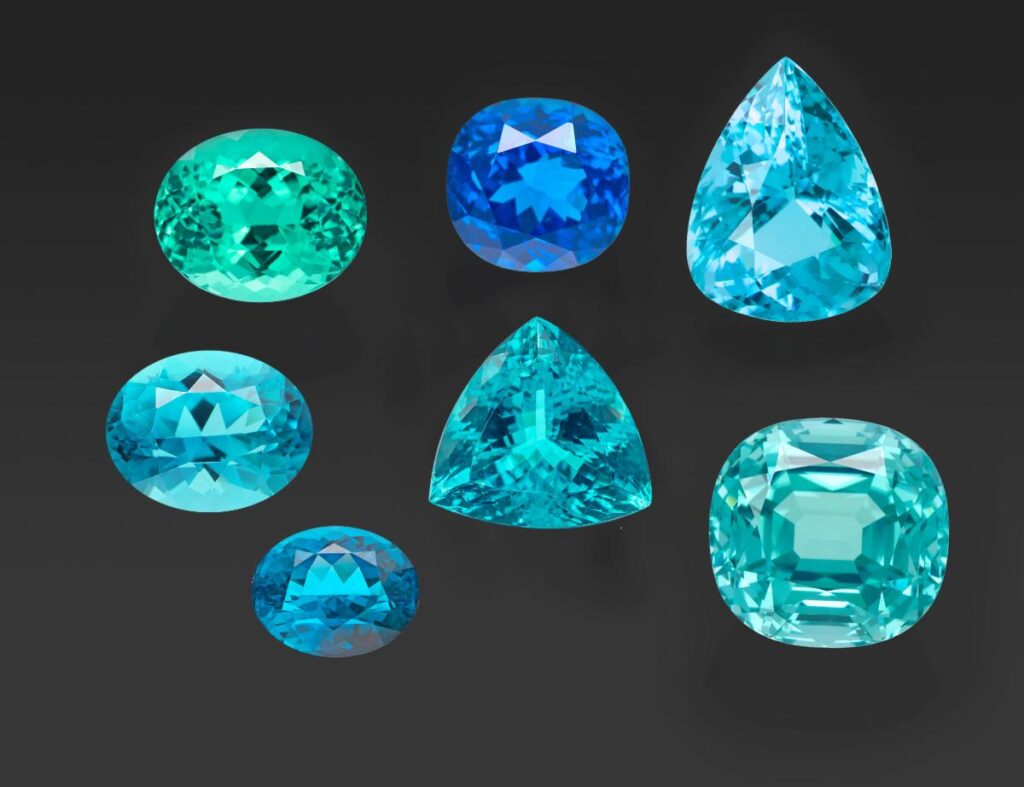
Basel: Copper-bearing tourmalines—widely known in the trade as Paraíba tourmalines—have captivated gem dealers, collectors, and enthusiasts around the world since they first appeared on the market in the late 1980s. The Swiss Gemmological Institute SSEF has received credible reports from trade sources that indicate a new deposit of copper-bearing tourmaline has been discovered in Ethiopia.
To date, the number of known sources of the sought-after gemstone have been few. It was originally discovered by Heitor Barbosa in a weathered pegmatite near the village of São José da Batalha in the Brazilian state of Paraíba, and immediately attracted worldwide attention for its exceptionally vivid blue to bluish-green colours, often described in the trade as “neon” or “electric.” These striking hues are primarily caused by the presence of copper within the tourmaline’s crystal structure.
Because production from the deposits in Paraíba and neighbouring state of Rio Grande do Norte were relatively limited, the discovery of additional sources in Nigeria and Mozambique in the early 2000s was very much welcomed by the gemstone trade. In the years that followed, Mozambique in particular became an important supplier of gem-quality copper-bearing tourmalines, producing stones in significantly larger quantities than before, and at times, of exceptional size, weighing several hundred carats.
The news that a new deposit of copper-bearing tourmaline has been discovered in Ethiopia coincides with the submission to SSEF of several Paraíba tourmalines for examination using existing analytical criteria and algorithms, whose geographic origin determination proved difficult, and in some cases inconclusive. It is hypothesised that these may be of Ethiopian origin.
Preliminary trace-element analyses of the copper-bearing tourmalines in question exhibited considerable overlap with stones from previously known localities, and particularly those from Brazil. As a result, origin determination may be challenging for certain specimens. To address this, ongoing research is focusing on thoroughly characterising this new material and refining the methods used to distinguish it from copper-bearing tourmalines from other origins.