


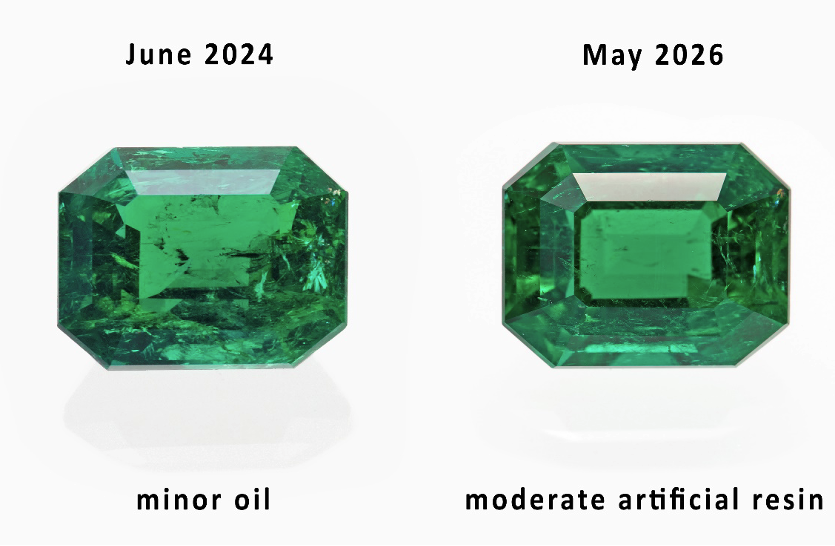
Basel: Based on a number of recent cases, the Swiss Gemmological Institute SSEF is issuing a trade alert concerning a fraudulent practice that has resurfaced in the emerald market. It concerns the filling of fissures in stones after they have been tested, with the emerald stone being offered for sale along with the earlier report that indicated little or no clarity modification.
Most emeralds contain fissures, and it is a long-established and fully accepted practice to reduce their visibility with colourless fillers such as oil, wax or artificial resin. However, disclosure of such treatments, including the amount of filler used, is mandatory under the harmonised Laboratory Manual Harmonisation Committee (LMHC) guidelines, because it directly affects an emerald’s value.
The high-end market today favours stones that are only treated with minimal amounts of oil, or with no clarity modification. As a result, many emeralds that previously were treated with artificial resin are being chemically cleaned with strong solvents to remove the filler.
Following the cleaning process, the emeralds that may now display prominent open fissures, are submitted to gem labs for testing. The reports that are issued will likely state that no or only minor clarity modification was evident at the time of testing.
Where fraud is committed is if the fissures are then re-filled either with oil or artificial resin, after the lab report has been issued, and the stone is presented to third parties along with the lab’s finding of “no or minor clarity modification.” The report is thus misleading because it no longer reflects the emerald’s current condition.
For precisely this reason, every statement on an SSEF report emphasises that the report only describes the condition of the stone at the time of testing. It makes no guarantee about the condition of the stone at any later date. If fissure filler is detected, SSEF discloses its presence, the amount of filler used, and the identity of the filler substance, such as oil, artificial resin or wax.
RECOMMENDATIONS TO THE TRADE:
- Verify every SSEF report’s authenticity and validity at www.myssef.ch.
- Re-check before purchase. Have any fissured emerald re-tested by SSEF immediately before a transaction, especially in cases where the report is not recent or the stone appears visually unusually clean relative to its present fissures.
- Be cautious of a clean-looking emerald accompanied by a “no clarity modification” report. Request that it be re-tested.
- Sellers should never circulate a report once a stone has been cleaned, re-filled or otherwise altered. Before a sale, submit the stone for a new report, reflecting its current state.
- Handle cleaned or heavily fissured emeralds with care. They are fragile and prone to chipping.
- Finally, while this alert focuses on emeralds, the same treatments and risks apply to any gemstone that contains fissures, with rubies being a notable example. This is a point not always fully appreciated within the trade.
SSEF remains available to re-test and re-issue reports and is glad to assist members of the trade with any questions on emerald treatment and disclosure.