


Macro Snapshot: The usual rate-driven case against holding bullion weakened in the week ending 20 November, yet gold and silver still suffered their worst week in months. According to the US Treasury’s daily yield curve, the 10-year yield fell to 4.92% from 5.15%, and the 30-year to 5.31% from 5.47%. Meanwhile, CME FedWatch pricing for the 9 December Fed meeting slipped to 23.9 basis points of tightening from 27.1, while the tightening priced through March fell to 48.1 basis points from 62.3. The University of Michigan’s final November survey also put year-ahead inflation expectations at 3.7%, below the 4.3% forecast. Despite all of this, COMEX gold lost 9.5% and silver 16.4%, and spot gold fell below $3,520 on 20 November, its lowest since September 2025, on course for its steepest weekly decline since the week ended 20 March, Reuters reported.
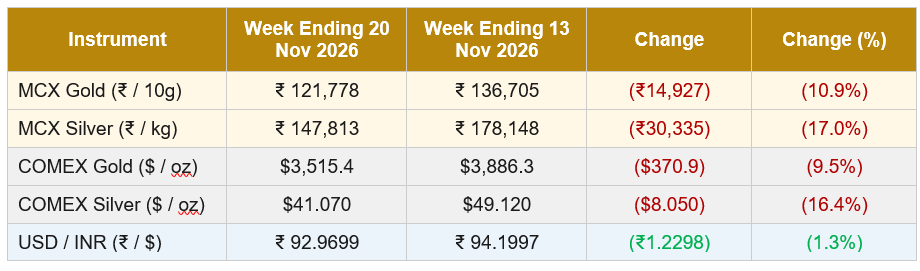
Equities, rather than rates, fit the week. MCX gold had already lost 6.8% by the close on Thursday, 19 November, even though the 10-year yield fell in every session; over the same days, the S&P 500 fell every day as AI-linked shares sold off. Then, on Friday, 20 November, the S&P 500 dropped another 3.7%, ending the week down 8.6%, its worst weekly loss in more than 18 months, according to AP, while MCX gold fell a further 4.45%. At the same time, the two-year Treasury yield fell to 4.63% from 4.76%, consistent with haven demand going into bonds rather than bullion. When gold falls with stocks while bond yields drop, it is acting as a source of cash, not a hedge, which fits investors selling what they could to cover losses elsewhere. If that reading is right, a durable floor in bullion is more likely to follow the end of the equity selloff than to precede it.
The hawkish news, meanwhile, was real but faded fast. Minutes of the 27 and 28 October meeting, released on 18 November, showed some officials had favoured an October hike, and a couple saw a case for more than a quarter point in December. Governor Christopher Waller also renewed his call for a more aggressive response to inflation the same day. By the close on 20 November, however, December pricing of 23.9 basis points no longer covered even one full quarter-point hike. Oil offered no support either. Brent’s January contract settled at $92.57, down 3.4% on the week, and WTI’s at $83.41, although both rose on Friday on Houthi threats and a CBS report that the US and Israel were weighing a new strike on Iran.
Back home, the rupee turned a global loss into a larger Indian one. The RBI reference rate strengthened from 94.1997 on 13 November to 92.9699 on 20 November, a gain of 1.3%, and the currency rose in all five sessions. PTI put the spot close at 92.67 (provisional) against 94.19 on 13 November, the first close stronger than 93 in more than seven months, helped by foreign buying of Indian equities and softer crude. As a result, MCX gold fell 10.9% against 9.5% on COMEX, with the currency accounting for most of the gap, while MCX silver’s 17.0% loss compared with 16.4% on COMEX.
Gold drivers: Indian demand, for its part, was holding up into mid-November. The World Gold Council’s India update of 17 November showed domestic discounts narrowing from an average of $66 an ounce in September to $5 by 12 November. Indian gold ETFs also drew inflows for a fifth straight month in October, with the trend extending into November. The wedding season now tests that demand at far lower prices.
Silver drivers: Silver fell harder, lifting the gold-silver ratio to about 85.6 from 79.1 on COMEX closes, and its industrial story offered no shelter while AI stocks led the selloff. The Silver Institute’s interim estimates, released on 12 November, still project a sixth straight deficit, although one narrowing to 35 million ounces from 54 million in 2025, with total demand down 5% to 1.08 billion ounces. Furthermore, Metals Focus put global silver ETP holdings down 55 million ounces in 2026 to 3 November, one reason silver looks more exposed than gold to forced selling.
Gold | MCX GOLD1!
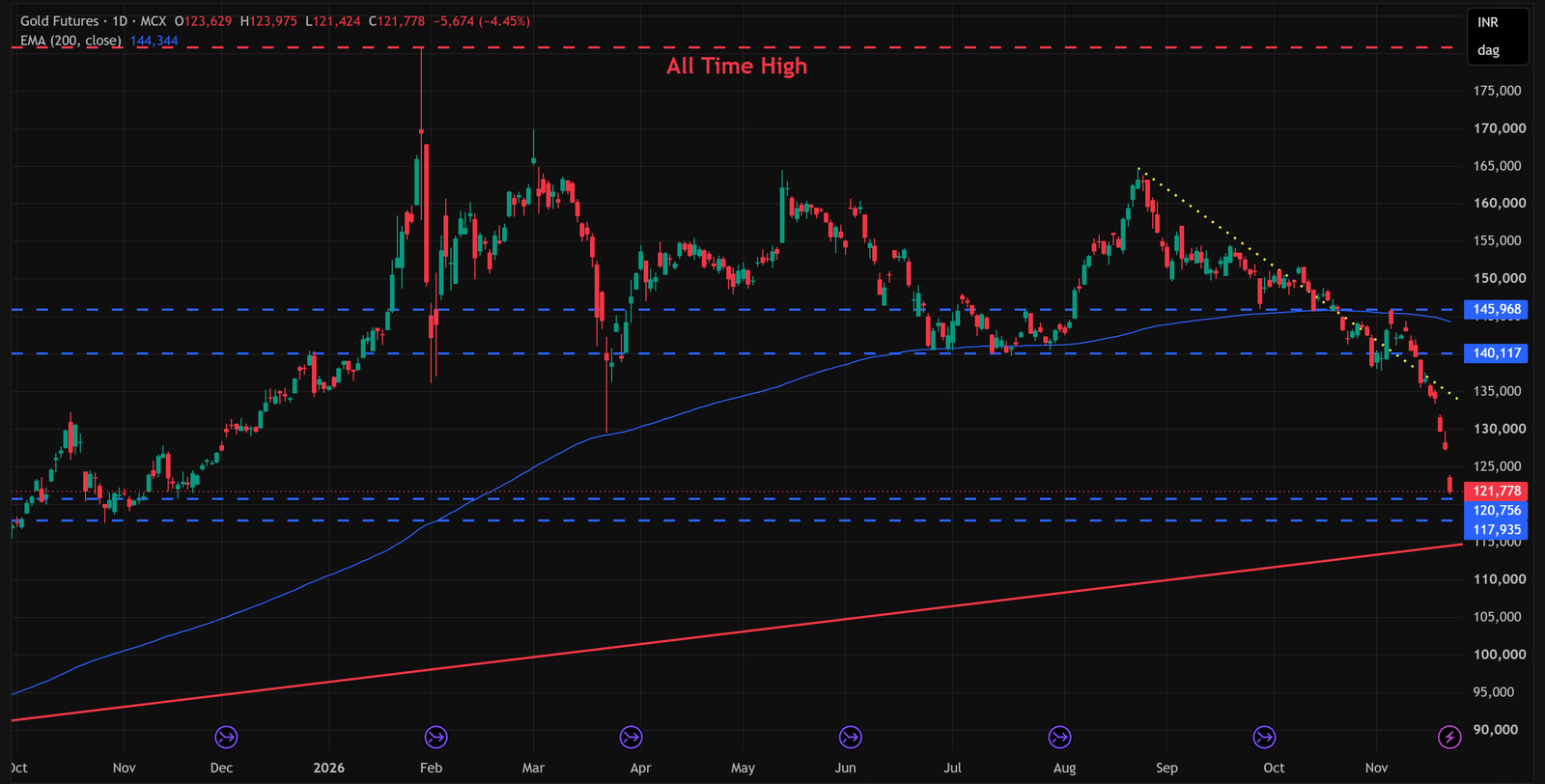
Gold’s decline turned disorderly in the week ending 20 November. Price had been sliding along the trendline from the late-August high, but then broke away from it in a run of gap-down sessions. On Friday, 20 November, the December contract opened at ₹123,629, about ₹3,800 below Thursday’s ₹127,452 close, and settled at ₹121,778, near the session low of ₹121,424. Moreover, no candle shows a long lower wick or a close well off the low, so the chart still records momentum rather than exhaustion.
Support has failed in a clean order. The ₹145,968 shelf and the 200-day EMA gave way in October, after which the July base near ₹140,117 broke in early November. The bounce that followed stalled at ₹145,968 and the EMA, forming the last lower high before the slide. As a result, price now sits about 15.6% below the 200-day EMA, an extension wide enough to make any short-covering rally sharp, although not one that marks a low on its own.
Price has now reached the zone that matters most. Friday’s close sits just above the ₹117,900 to ₹120,800 band, where buyers stepped in during late October and November 2025, before the rally that carried gold to its January 2026 record. A daily close below ₹117,935, by contrast, would mean the base has failed, leaving the long-term rising trendline on the chart as the next reference.
| Key Takeaway: Gold is in a confirmed, accelerating breakdown, and it is now testing its 2025 base at ₹117,900 to ₹120,800. The first evidence of a turn would be a daily close back above Thursday’s ₹127,452, which would fill the 20 November gap. Until then, any bounce is a reaction, not a reversal. |
Silver | MCX SILVER1!
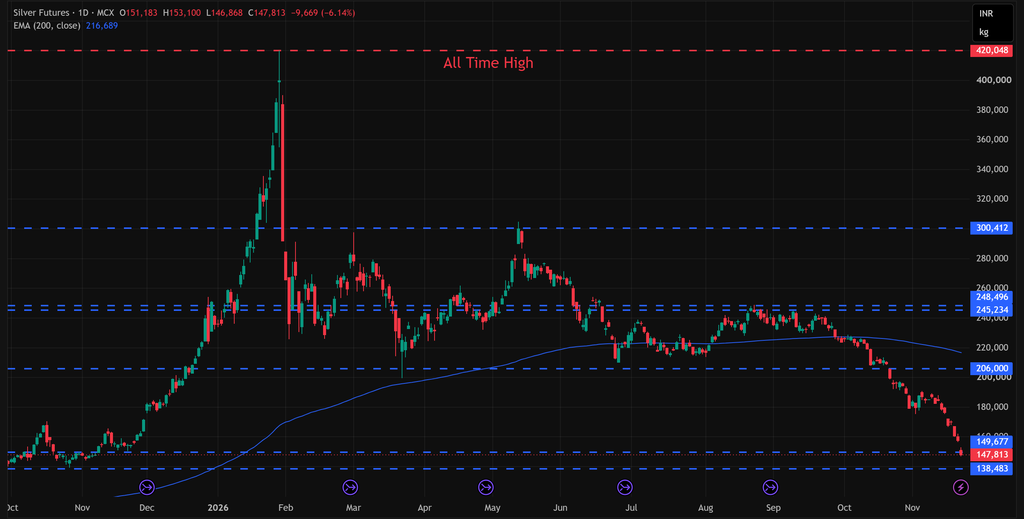
Silver’s structure is weaker than gold’s. The December contract fell through ₹206,000 with a gap in late October, bounced to around ₹190,000 in early November and failed there, and then fell 17% in the five sessions to 20 November. Friday’s session, in turn, opened at ₹151,183, about ₹6,300 below Thursday’s ₹157,482 close, and settled at ₹147,813, near its ₹146,868 low.
Price is now about 32% below the 200-day EMA of ₹216,689 and about 65% below the ₹420,048 January peak. Both are capitulation-scale distances; even so, no session has yet produced a sharp recovery off its low.
Unlike gold, silver has already lost the first of its 2025 levels. Friday’s close sits below ₹149,677, the line that marked the late-2025 base, which now turns from support into the first hurdle on any rebound. Below it, the ₹138,500 area is the next demand zone, where silver last found buyers in October and November 2025 before its run to the January record.
| Key Takeaway: Silver is in an extended, confirmed breakdown and has already closed below its first 2025 level at ₹149,677. A close back above that line would be the first sign that forced selling is easing; until then, rallies are better read as short-covering, with ₹138,500 the next demand zone. |
Buy Now or Wait?
If you need metal: Jewellers with wedding orders gain little by chasing the exact bottom. Spreading gold purchases across the ₹117,900 to ₹120,800 base, and keeping part of the silver budget for the ₹138,500 area, keeps the average cost close to support without betting on a single price.
If you can wait: Neither chart has yet produced a reversal signal. For gold, the first would be a daily close above ₹127,452; for silver, a close back above ₹149,677. Until one prints, buying is a bet that support will hold; a stabilising stock market would strengthen either signal.
The line that changes the plan: A daily close below ₹117,935 in gold, or below ₹138,500 in silver, would mean the 2025 base has given way. At that point, pausing purchases is more prudent than averaging down.
Watch in the Days Ahead:
- Wall Street: Bullion is trading with equities. A session in which stocks fall and gold holds would be the first sign that the selling is exhausting.
- US PCE, 25 November: A soft October print would extend the retreat in rate expectations; a hot one, however, would revive the half-point debate before the 9 December Fed decision.
- Rupee: A pause in foreign equity inflows would weaken the rupee and, in turn, cushion MCX prices.
Disclaimer: Content in this column is for information only. The scenarios above describe how price levels can inform purchase timing and are not recommendations to buy or sell any security or commodity derivative.
Authored by Dhawal Chotai