


Snap Shot: Most of the damage in the week ending 2 October landed before the good news arrived, and the good news then failed to repair it. August core PCE inflation, released on 30 September, rose 3.0% from a year earlier against expectations of 3.3%, helped partly by methodology changes at the Bureau of Economic Analysis. September payrolls on 2 October then added just 29,000 jobs against forecasts near 90,000, with unemployment at 4.2% and August revised down to 133,000 from 162,000. CME FedWatch put the chance of an October hike at 17% after the jobs report, while prediction-market odds had stood near 70% on 25 September.
The long end of the Treasury curve ignored the signal. The 10-year yield breached a level last seen in April 2002 on 1 October and closed 2 October near 5.28%, about 11 basis points higher on the week, while the 30-year finished near 5.62%, roughly 13 basis points higher. The dollar index traded near 101.9 on 1 October. For bullion the uncomfortable point is that a collapse in October hike odds bought only a modest rebound, because the yields that set the opportunity cost of holding gold kept rising regardless.
Oil supplied the first shock. Brent topped $107 on 28 September after Washington rejected an Iranian proposal to reopen the Strait of Hormuz, and spot gold fell 3.3% that day to its lowest since 5 August while silver lost 4.7%. Brent jumped again on 1 October when Chinese refiners suspended fuel exports for October, before a Group of Seven plan to release up to 100 million barrels of diesel and other emergency reserves pulled prices back on 2 October. Brent settled at $102.25 on its new December contract, which rules out a clean weekly comparison, and West Texas Intermediate at $91.11, down 1.4%.
The rupee carried the strain at home, breaching 96 intraday on 28 and 29 September, holding near 95.95 on suspected Reserve Bank intervention and then falling 37 paise on 1 October to a provisional 96.31, its weakest in more than two months. Foreign portfolio investors had sold over ₹20,000 crore of equities across 29 and 30 September, lifting September’s outflow to ₹35,860 crore, the highest since April.
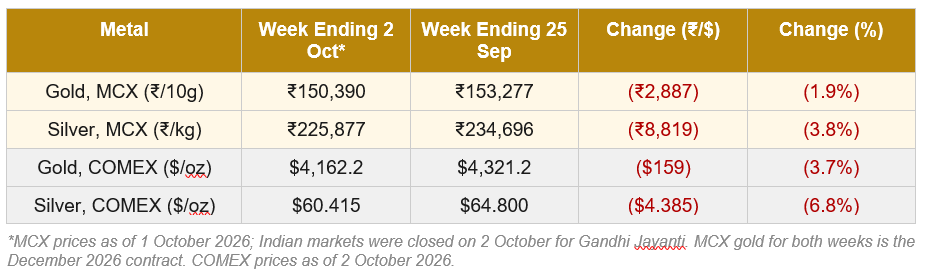
Measured on like-for-like December contracts, MCX gold fell 1.9% and silver 3.8% against COMEX losses of 3.7% and 6.8%, yet most of that gap is arithmetic rather than resilience. COMEX gold lost 0.95% and silver 1.24% on 2 October, a session India never traded, and the rupee’s slide of roughly half a percent supplied another slice. Strip both out and India’s gold basis barely moved, while silver’s firmed by roughly 1.3 percentage points, the one part of the cushion that reflects domestic buying rather than the calendar or the currency.
Gold-specific drivers: Forecasters split on what the yield shock means. Kitco reported on 28 September that State Street’s Doshi sees rising bond yields pushing gold toward $4,000 while still expecting $5,000 by the second quarter of 2027, and on 29 September that Natixis sees $4,100 by year-end. At home, the flat gold basis means Indian prices fell almost exactly as far as dollar gold and the rupee implied, so domestic demand neither cushioned nor amplified the move.
Silver-specific drivers: Silver absorbed the larger hit, and the COMEX gold-silver ratio widened from 66.7 to 68.9 as most of its 6.8% weekly loss landed in the 28 September session. Deutsche Bank’s Ghali told Kitco on 2 October that silver faces oversupply even as gold’s resilience supports its outlook. India’s response ran the other way: a domestic basis that firmed by about 1.3 percentage points while COMEX fell suggests local buyers absorbed part of the decline at prices last seen in early August.
Gold | MCX GOLD1!
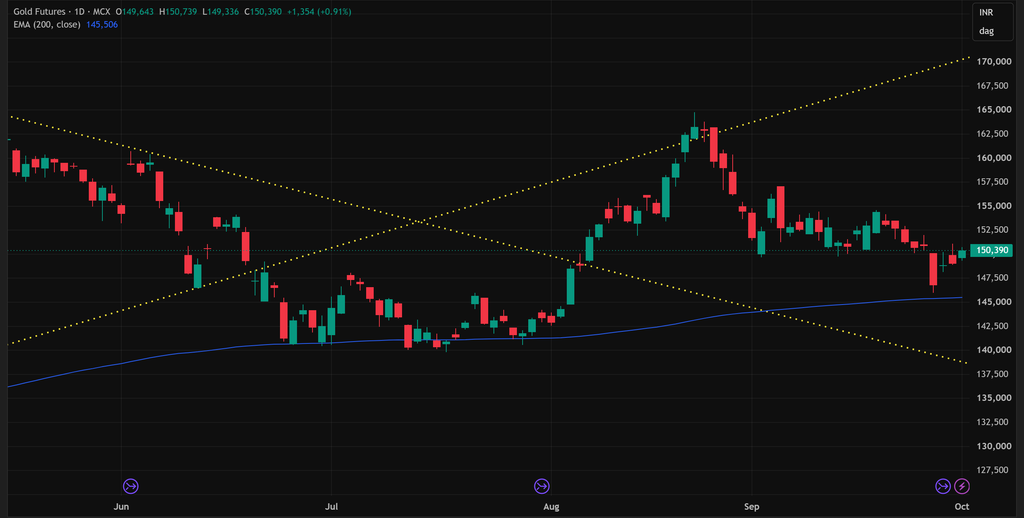
MCX gold’s continuous chart switched from the October to the December contract during the week ending 2 October, which changes how it should be read. On 28 September, still on the October contract, gold broke its September floor of ₹150,000 to ₹150,500 decisively, closing near ₹146,800 after probing ₹146,000, within roughly ₹500 of the 200-day exponential moving average. The apparent recovery to ₹150,390 is partly the switch itself, because December traded ₹2,396 above October on 25 September.
Translated to December prices, the broken floor sits near ₹152,400 to ₹152,900, and the 1 October close remains beneath it. The session itself was constructive, a range of ₹149,336 to ₹150,739 closing near the high, but it stopped short of the 30 September wick near ₹151,000. Structure now reads as a downtrend inside a longer uptrend: lower highs since the late-August peak near ₹164,800, lower highs through September and a fresh lower low on 28 September, all still above a rising 200-day average. The chart shows that average at ₹145,506, but it is built mostly from October prices; on December terms it sits roughly ₹2,000 to ₹2,400 higher, near ₹147,500 to ₹147,900, leaving the close less than 2% above it rather than the 3.4% the chart implies.
On the December contract, resistance begins at ₹151,000 and extends to the ₹152,400 to ₹152,900 zone where the old floor now sits; a daily close above it would turn the 28 September break into a failed breakdown. Support lies near ₹148,400, roughly the December equivalent of the 28 September low, with the December-adjusted 200-day average just beneath at ₹147,500 to ₹147,900, which makes that band the line between a correction and a trend change.
| Key Takeaway: Gold has broken its September range, and the continuous chart overstates the repair because of the contract switch. All else equal, Friday’s 0.95% COMEX decline would put the December contract near ₹149,000 when MCX reopens on 5 October, before any move in the rupee. Indian buyers should treat ₹152,400 to ₹152,900 as the zone that would restore the range. |
Silver | MCX SILVER1!
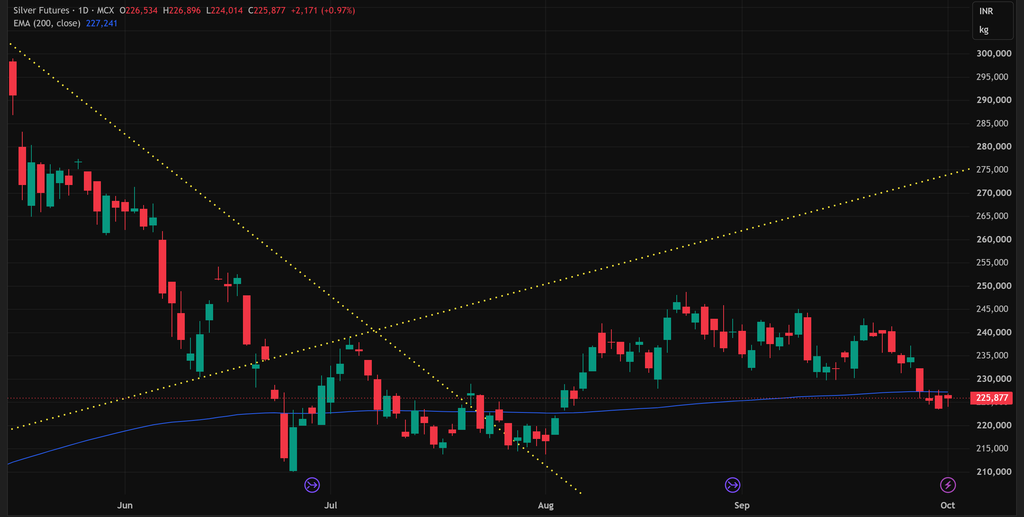
Silver’s chart carries no contract switch, which makes its signal cleaner and its message more bearish. The December contract broke the ₹229,500 to ₹232,000 floor that had held since mid-August with a wide red candle on 28 September. Price then closed below the 200-day exponential moving average at ₹227,241 on 29 September, 30 September and 1 October, its first sustained spell beneath the average since early August.
The 1 October session exposed the change in character. Silver opened at ₹226,534, reached only ₹226,896 and closed at ₹225,877, failing to touch the 200-day average even on a 0.97% daily gain. A rally that cannot reach the average from below marks it as resistance, and the old range floor above it becomes a second ceiling.
Resistance now runs from ₹227,000 to ₹227,300 and then ₹229,500 to ₹232,000. Support sits near ₹223,500, the 30 September low, then ₹220,000, where the early-August advance began, and ₹214,000 to ₹216,000, the late-July lows. A daily close back above ₹232,000 would be needed before the breakdown could be called a false move.
| Key Takeaway: Silver has broken down rather than merely tested support, and the failed retest of the 200-day average confirms it. Friday’s COMEX loss implies roughly ₹223,000 at the reopening, all else equal, which lands on the 30 September low. Stockists reading the firmer domestic basis as a floor should note that ₹223,500 is the level the trade now has to defend. |
Watch in the Days Ahead:
- Reopening and the RBI: MCX and the rupee absorb Friday’s global moves on 5 October, the day the Reserve Bank’s policy committee begins meeting. Its 7 October decision, with the repo rate at 5.25%, will set the tone for a rupee trading near 96.
- US data versus the long end: ISM services on 5 October, then September CPI and PPI before the 27 to 28 October FOMC. Softer prints help metals only if they pull the 10-year back below 5.2%; a push past the high of 1 October extends the pressure regardless of Fed pricing.
- Oil and the G7 release: Delivery of the emergency barrels would ease the inflation channel; renewed Hormuz escalation would put Brent’s $107 high of 28 September back in view.
- Levels: Gold (December) resistance ₹151,000, then ₹152,400 to ₹152,900; support ₹147,500 to ₹148,400. Silver resistance ₹227,000 to ₹227,300; support ₹223,500 and ₹220,000.
Disclaimer: This column is for information only and does not constitute investment advice. Prices and levels cited are based on data available at the time of writing. Readers should consult a qualified advisor before making trading or investment decisions.
Authored by Dhawal Chotai