


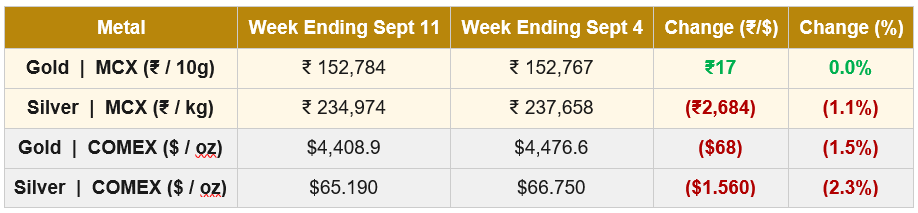
Macro Snapshot: Gold on COMEX fell 1.5% to $4,408.9 in the week ending 11 September, while gold on MCX closed at ₹152,784, seventeen rupees above where it began. Indian holders will read that as protection, and for one week it was. The more useful reading is that the position is safe only while the war continues.
Trace the chain backwards from the oil market. Brent closed at $104.61 on 11 September per Trading Economics, its highest since May, on Gulf escalation that included Houthi forces advancing on Yemen’s Perim Island and Saudi Arabia shutting its East-West pipeline. The weekly gain of roughly 9% followed an 8% gain in the previous five sessions, leaving Brent close to a fifth higher than on 28 August. Energy costs moving at that speed do not stay inside the energy market.
August CPI, released on 11 September, duly ran hot, rising 0.4% on the month and 3.4% on the year with gasoline up 3.9% and energy up 2.1%, while core printed 0.3% monthly and 2.4% annually, a tenth above forecast. CME FedWatch pushed September rate-hike odds to roughly 90% within hours, and the 10-year Treasury yield closed at 4.96% per Advisor Perspectives, eighteen basis points above the 4.78% of 4 September. The 30-year closed at 5.36%, up twelve basis points from 5.24%, so the spread between tens and thirties narrowed from 46 to 40 basis points: the front and the belly led this selloff, which marks it as a repricing of the Fed rather than a long-run inflation scare. Gold booked a third consecutive weekly loss in dollars, remarkable given that a shooting conflict was widening in the Gulf at the same time.
For the rupee, an oil shock of that magnitude lands on the import bill, and foreign investors were leaving at the same time, with FPIs pulling ₹13,138 crore from Indian equities during September per Business Standard. The currency slid from 94.57 on 7 September to 95.60 on 11 September per MTFX rates, a depreciation of roughly 1.1%. The arithmetic finishes the job: a 1.5% fall in dollar gold against a 1.1% weaker rupee leaves the MCX price effectively unchanged, which is what the tape delivered. Silver got the same cushion and still finished lower, its 2.3% dollar decline larger than the currency could absorb. A currency hedge, it turns out, is a fixed-size shield rather than an unlimited one. The uncomfortable corollary is that the shield is made of the same material as the threat. Peace in the Gulf would pull the war premium out of dollar gold and strengthen the rupee at once, so domestic prices would fall on both legs while COMEX fell on one. Indian holders have deferred the dollar decline rather than escaped it.
Gold-specific drivers. Gold’s difficulty in dollars is that the inflation it exists to hedge arrived in a form arguing for higher rates, since energy shocks push a central bank toward tightening, and tightening raises the cost of holding an asset that pays nothing. Central-bank demand remains the counterweight, with Q2 2026 official-sector purchases of 289 tonnes, up 62% year on year, and the June WGC survey showing a record 45% of central banks planning to add. Domestically, the 13 May duty hike from 6% to 15% and the capped Advance Authorisation regime still set the arbitrage, and a rupee at 95.60 raises the landed cost regardless of where COMEX trades.
Silver-specific drivers. Silver had the worse week on both exchanges, and the gold-silver ratio widened to 67.6 from 66.7, the direction that signals the monetary hedge gaining on the industrial-plus-monetary trade. Monarch PMS’s 28 August framework put its silver midpoint at $65 against a 60x benchmark ratio, making this a clean test: silver at $65.19 sits on that midpoint while the ratio drifts the wrong way. The Silver Institute’s sixth consecutive global deficit of 215 Moz is the structural case against that drift.
Gold | MCX GOLD1!
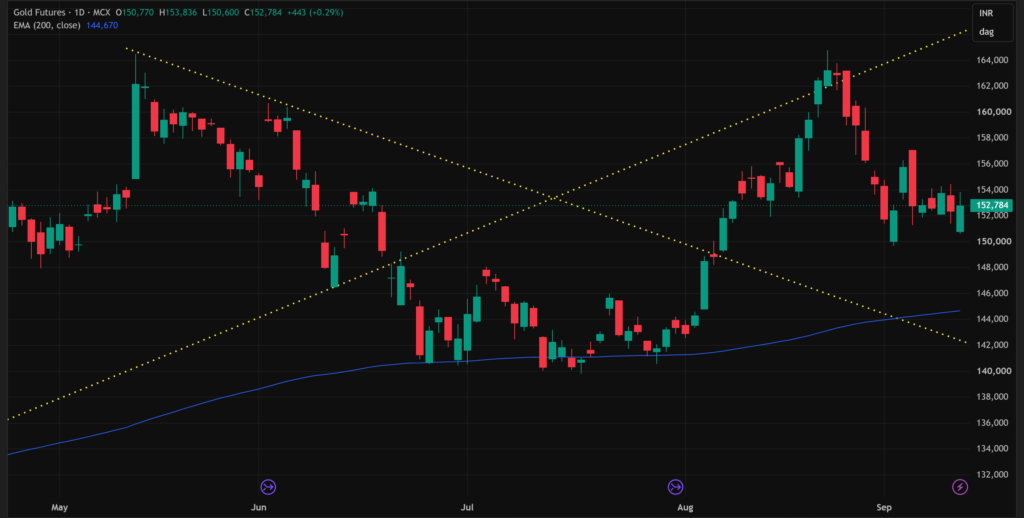
Gold has moved from correction into compression, a more interesting condition than it sounds. Price closed at ₹152,784, up 0.29%, after opening at ₹150,770, trading down to ₹150,600 and recovering to touch ₹153,836. The 200-day EMA has risen to ₹144,670, leaving over ₹8,000 of cushion beneath the market, so the medium-term structure holds even though the move from the ₹164,000 peak interrupted the earlier expansion.
The rejection from ₹162,000-164,000 and the slide toward ₹150,000 did real damage, carrying gold through ₹158,000, ₹156,000 and ₹154,000 in consecutive lower closes, and the rebound toward ₹156,000-157,000 failed to reclaim that zone. What has changed is that sellers have stopped making progress. Price has oscillated between roughly ₹151,000 and ₹155,000, and the lower wick on the latest candle shows buyers defending ₹150,500-151,000, even as a close below the session high shows they have not taken control above ₹153,500-154,000.
The horizontal levels now matter more than the trendlines, neither of which coincides with meaningful price reaction. Resistance sits at ₹154,000-156,000, where several rebounds have stalled, and a daily close above ₹156,000 with follow-through would improve the short-term structure. Support at ₹150,000-151,000 has been defended more than once, which lends it weight; a close beneath it would expose ₹147,500-149,000 and eventually ₹144,500-145,000 near the rising 200-day EMA.
The asymmetry is worth naming: a decline into ₹147,000-149,000 would still register as a normal retracement given the distance above the EMA, whereas a break above ₹156,000 would reclaim the most obvious recent lower high and therefore carry more information.
| Key Takeaway: Compression after correction rather than reversal, with sellers unable to break ₹150,000-151,000 and buyers unable to clear ₹154,000-156,000. The next decisive move out of that band sets direction. For Indian holders the rupee has been doing the work the chart has not, which lasts precisely as long as the currency keeps sliding. |
Silver | MCX SILVER1!
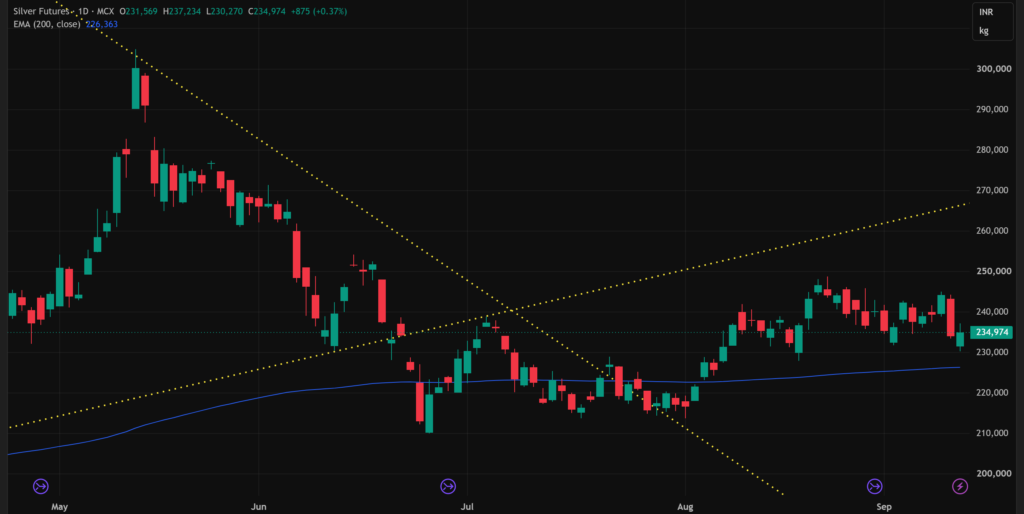
Silver is range-building above its longer-term reference rather than breaking down, a distinction that matters more than the weekly percentage suggests. Price closed at ₹234,974, up 0.37%, after opening at ₹231,569, falling to ₹230,270 and recovering to ₹237,234, with the 200-day EMA at ₹226,363 below.
Failure to sustain trade above ₹244,000-248,000 remains the defining feature, with repeated attempts meeting supply and price oscillating between roughly ₹236,000 and ₹244,000. Unlike gold, silver has avoided a comparably deep collapse, and pullbacks keep finding buyers around ₹231,000-234,000, preserving a series of higher reactions from the July and August base.
The latest candle carries that message. Recovery from ₹230,270 to a ₹234,974 close shows real demand at the lower end of the range, though closing below the session high makes it a supportive reaction rather than a reversal. Silver has not produced a convincing lower low on the larger timeframe, which is why the evidence supports consolidation with a mild bearish tilt.
Support at ₹231,000-233,000 preserves the structure, and losing it opens ₹227,000-229,000, where the 200-day EMA becomes relevant and beneath which the medium-term thesis takes real damage. Above the market, ₹240,000-242,000 is the first hurdle and ₹244,000-248,000 the consequential one, with a close above ₹248,000 converting the range into a continuation setup.
| Key Takeaway: Range-bound with a constructive medium-term bias, defended at ₹231,000-233,000 and capped at ₹244,000-248,000. Silver’s correction has been shallower than gold’s and its support has held more consistently, the stronger structure of the two despite the worse weekly print. The gold-silver ratio is the tell: drifting to 67.6 from 66.7 runs against the silver case, and a move through 70 would confirm it. |
Watch in the Days Ahead
- FOMC decision (Sep 16-17). With a hike near 90% priced, the dot plot and the language will do the moving rather than the decision. Guidance treating energy-driven inflation as transitory would relieve gold; treating it as embedded would extend the correction toward ₹150,000.
- Hormuz talks in Oman (Sep 14). Iranian state media has flagged a meeting with Gulf Cooperation Council diplomats. Progress is the single largest downside risk to MCX prices, since de-escalation removes the war premium from dollar gold and strengthens the rupee at once, and domestic holders take both hits together.
- The rupee at 95.60 and the RBI. Whether the RBI defends 96 decides whether the cushion persists. A defended rupee transmits the full dollar move to MCX prices.
- Key technical levels. Gold support ₹150,000-151,000, then ₹147,500-149,000; resistance ₹154,000-156,000, then ₹158,000-160,000. Silver support ₹231,000-233,000, then ₹227,000-229,000; resistance ₹240,000-242,000, then ₹244,000-248,000.
Disclaimer: This column is for informational and educational purposes only and does not constitute investment advice, an offer to buy or sell, or a solicitation of any security or commodity. Data and price levels are sourced from public releases and market data providers as cited. Readers should conduct their own due diligence and consult a licensed advisor before acting.
Authored by Dhawal Chotai