


Macro Snapshot: The week ending September 4 was a whipsaw for the Fed narrative and a mid-cycle divergence week for the metals. Kevin Warsh’s hawkish August 28 legacy carried into the open with CME FedWatch showing roughly 66% September rate-hike odds. Fed Governor Christopher Waller’s September 3 speech pushed back: he indicated support for holding rates steady if August inflation cooled, and hike odds trimmed toward 50%. Then August NFP on September 4 came in at 162,000 against a 53,000 consensus, with unemployment steady at 4.1% and prior months revised up (June +11k, July +44k, per BLS). Money-market pricing swung back toward a hike within minutes, and gold slid.
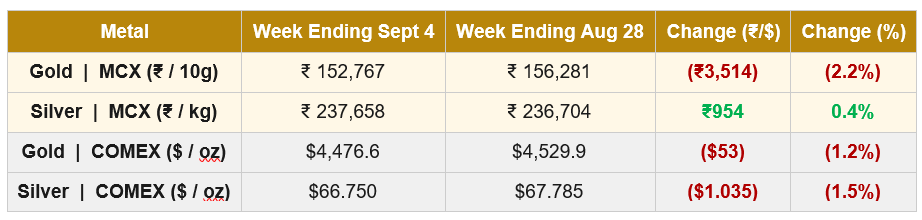
The USD/INR pair moved against the Fed narrative. Per MTFX mid-market rates, the rupee strengthened from 95.14 on August 31 to 94.44 on September 4, a 1.1% appreciation despite the oil rally and re-firming rate-hike odds. Rupee strength changed the MCX-vs-COMEX arithmetic: gold MCX (down 2.2%) fell only about 1 percentage point more than gold COMEX (down 1.2%), roughly what pure rupee math explains. Silver was the outlier: MCX rose 0.4% while COMEX fell 1.5%, a nearly 2 percentage point divergence, with Indian physical premiums implied by the arithmetic widening by roughly ₹5,000-6,000 per kg over the reporting period.
The geopolitical backdrop escalated meaningfully. Iran and the US exchanged missile strikes during the week, Iran reportedly struck Kuwait, and Israel’s defense minister threatened crippling attacks on Iran’s infrastructure. Brent crude closed at $96.28 on September 4 per Trading Economics, up roughly 8% on the week, its strongest weekly performance since July. WTI held around $92. US Treasury yields firmed: the 10-year closed at 4.78% on September 4 per the Forbes Advisor tracker and the Fed H.15 release, up 5 basis points from the August 28 close of 4.73%, and the 30-year sat at 5.24%. Real yields staying firm is what kept gold from converting the Iran risk premium into a decisive rally.
Gold-specific drivers: Central-bank demand and geopolitics competed with real yields, and real yields won. Q2 2026 official-sector purchases were 289 tonnes (+62% YoY); the June WGC survey still shows a record 45% of central banks planning to increase holdings. Monarch PMS’s August 28 note flagged the 10-year TIPS real yield at 2.41% as the principal cited headwind to gold, and the September 4 tape supports that call. Domestically, the May 13 duty hike (6% to 15%) and capped Advance Authorisation regime continue to shape the arbitrage. The domestic gold discount implied by MCX and rupee compressed only modestly across the reporting period, suggesting Indian physical demand held rather than accelerated at the ₹152,000-155,000 zone.
Silver-specific drivers: The story of the reporting period. Silver COMEX fell 1.5% while silver MCX rose 0.4%, and the ~2 percentage point divergence was carried by Indian physical premium widening, not rupee arithmetic alone. Silver Institute’s 2026 World Silver Survey continues to project a sixth consecutive global supply deficit at 215 Moz. Monarch PMS’s August 28 note reinforces the structural setup: 762 Moz drawn from above-ground stocks since 2021, mine supply flat for a decade, and COMEX paper claims roughly 5.6x registered physical inventory, which is the mechanical case for tail-heavy silver upside if demand strengthens. Monarch’s base-case year-end 2026 range for silver is $70-85; bull case $95-120. Silver at $66.75 sits at their $65 model midpoint, making it the cheaper of the two metals on their framework.
Gold | MCX GOLD1!
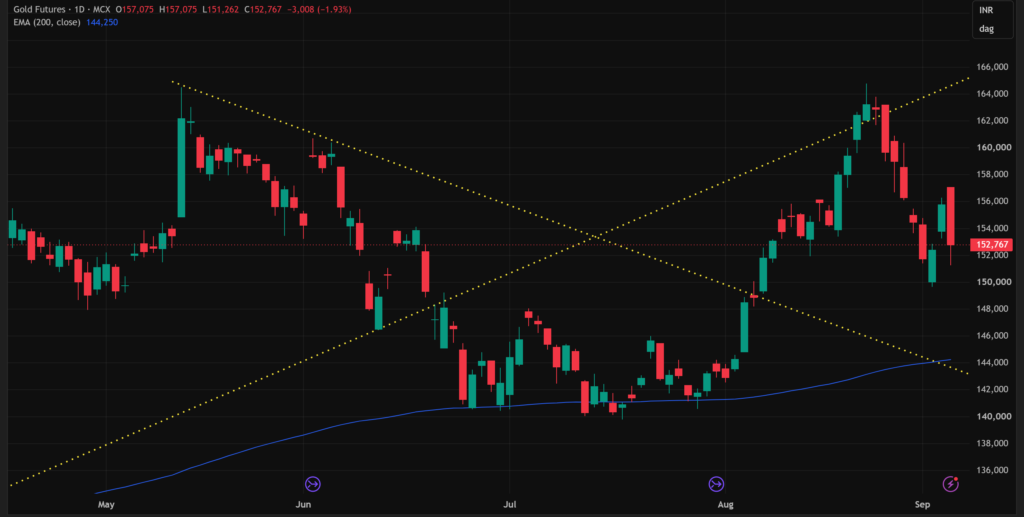
Gold’s short-term structure has deteriorated meaningfully. Price closed at ₹152,767, down 1.93%, after opening at ₹157,075, failing to trade higher, and falling to ₹151,262. The 200-day EMA at ₹144,250 keeps the broader trend intact, but the medium-term uptrend now has real damage from the top down.
The most important development is the failed recovery near ₹156,000-157,000. Gold rebounded from around ₹150,000 toward that band earlier in the reporting period, then produced the September 4 rejection candle. The rebound was rejected rather than accepted, and sellers defended the breakdown zone. Short-term structure has consequently shifted from higher-highs/higher-lows to lower-high, lower-low: the late-August peak around ₹164,000-165,000 is the major swing high; the September 2-3 rebound is the lower high; the close below ₹154,000-155,000 opens the first lower-low sequence.
The immediate battleground is ₹150,000-152,000, where the recent rebound originated. A weak close below that zone opens ₹147,500-149,000 and potentially the rising 200-day EMA around ₹144,250. On the upside, ₹156,000-157,000 is now first repair; a reclaim of ₹158,000-160,000 is needed before the late-August high becomes relevant again. A quick reclaim of ₹154,000-156,000 would let a bullish case argue that the current move is a deeper but still corrective retracement.
| Key Takeaway: Early breakdown within a still-supported longer-term trend. Failed rebound plus lower-low sequence favours a test of ₹150,000-152,000. Losing that zone would materially deepen the correction; reclaiming ₹154,000-156,000 quickly would rebuild the corrective read. For Indian trade positioning, the ₹150,000 zone is where physical demand has historically re-engaged at scale. |
Silver | MCX SILVER1!
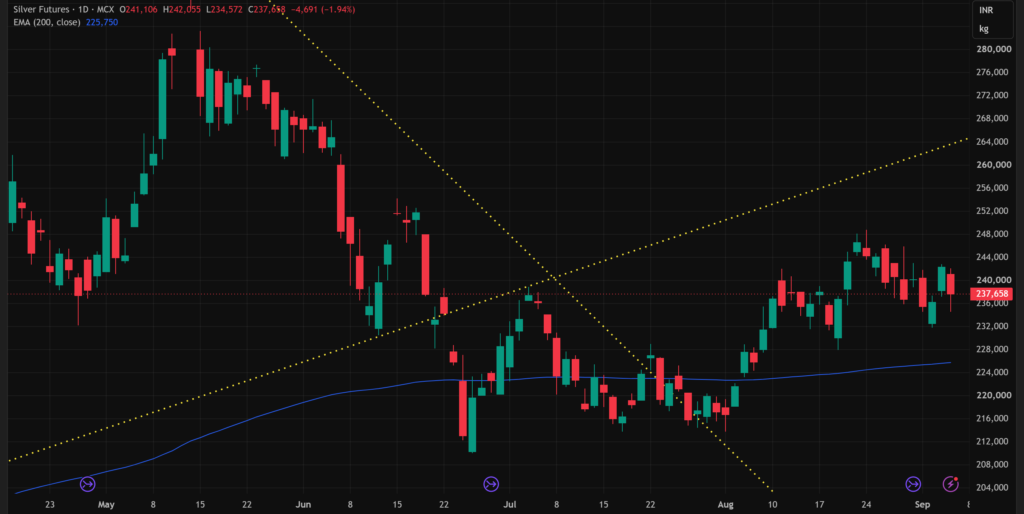
Silver’s chart is less decisively bearish than gold’s. Price closed at ₹237,658, down 1.94%, after opening at ₹241,106, printing ₹242,055 high and ₹234,572 low. The 200-day EMA at ₹225,750 sits comfortably below, and the market has not yet broken a major nearby floor on a closing basis.
Silver has been unable to sustain trade above roughly ₹242,000-248,000, printing a succession of lower reaction highs. The September 4 candle adds to the evidence: wide range, weak close, substantial intraday reversal. Even so, the market is still consolidating between roughly ₹234,000-236,000 support and ₹244,000-248,000 supply, not breaking down. Sellers have shown they can push silver sharply lower but have not yet demonstrated control below the range floor. Calling it a breakdown would be premature.
The active question is whether ₹234,000-236,000 holds. Silver has repeatedly found demand there during the current consolidation. A decisive close below the zone would convert current weakness into an early breakdown and expose ₹230,000-232,000, then the more significant ₹225,000-228,000 region, which includes the 200-day EMA. Above the market, ₹240,000-242,000 begins repair; the stronger bullish trigger sits at ₹244,000-248,000, where the recent rally repeatedly met supply.
| Key Takeaway: Consolidating with a bearish near-term tilt, but the range floor at ₹234,000-236,000 is still intact. Silver is structurally stronger than gold on the chart: gold produced a lower high and moved below important support; silver did neither. Indian physical premiums are the tell, and the gold-silver ratio at 69x (against Monarch PMS’s 60x model benchmark) makes silver relatively cheap on that framework. Watch whether silver MCX can hold ₹235,000 into the September 16-17 FOMC. |
Watch in the Days Ahead:
- US August CPI (Sep 11). The Fed’s September 16-17 decision hinges on this print. A soft core (below 0.2% MoM) restores the Waller-style hold read and would be an unambiguous bullish catalyst. A firm or above-consensus core keeps hike optionality alive and pressures gold’s ₹150,000-152,000 support.
- FOMC decision (Sep 16-17). Baseline is a hold on cooling August CPI; a hike would test gold’s ₹147,500-149,000 support and silver’s ₹230,000-232,000 zone. Dot-plot revisions matter as much as the decision itself.
- Iran escalation trajectory. Any further Iran-Gulf strikes or Israeli infrastructure action would push Brent through $100 and re-engage the safe-haven bid for gold. De-escalation would remove one of the two active bullish props.
- Silver MCX premium and range floor. Whether MCX silver can hold ₹235,000-237,000 is the cleanest tell for whether Indian physical demand is genuinely accelerating or just a one-week arithmetic quirk. Widening premiums into the days ahead confirm the divergence thesis.
- Key technical levels. Gold support ₹150,000-152,000, then ₹147,500-149,000; resistance ₹156,000-157,000, then ₹158,000-160,000. Silver support ₹234,000-236,000, then ₹230,000-232,000, then ₹225,000-228,000; resistance ₹240,000-242,000, then ₹244,000-248,000.
Authored by Dhawal Chotai