


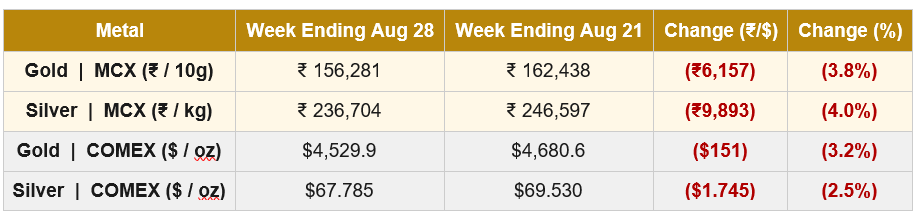
Macro Snapshot: The correction in gold and silver during the week ending August 28 was a confluence event. Both metals had rallied into well-defined supply zones (gold at ₹162,000-164,000, silver at ₹244,000-248,000) and were showing early signs of exhaustion. Into that setup, the July PCE release on August 26 came in hot on the headline (3.7% year over year against 3.6% consensus), and Federal Reserve Chair Kevin Warsh’s August 28 Jackson Hole address leaned decisively hawkish on inflation. The trigger was monetary. The setup was technical. Both metals turned exactly where they had to. Oil eased, the geopolitical risk premium moderated after the August 26 Iran-Oman phased framework for a temporary shipping corridor through the Strait of Hormuz, and the rupee actually strengthened. None of the usual cushions was available.
The July PCE release on August 26 showed headline inflation at 3.7% year over year, above the 3.6% consensus; core held at 3.3%, in line. Headline PCE has stayed at 3.7% for two consecutive months, and the six-month annualised pace flagged by Warsh on Friday was 4.1%. Warsh emphasised that “inflation is running above our 2 percent target” and that the Committee “must be confident that underlying inflation is moving to our objective, clearly and at sufficient speed.” CME FedWatch, which had leaned toward a September hold going into the week, shifted to roughly 60/40 hold-versus-hike, with December odds tilted the same direction. The September decision is now genuinely two-sided.
The USD/INR pair traded a narrow band per MTFX mid-market rates, from about 95.77 on August 24 to a low near 95.15 on August 25, closing around 95.49 on August 28: a slight rupee strengthening. Direction shows in the arithmetic. Gold MCX fell 3.8% while COMEX fell 3.2%; silver MCX fell 4.0% while COMEX fell 2.5%. For most of the last two years the rupee has cushioned Indian holders on down weeks. During the week ending August 28, it did the opposite.
Oil removed a supportive leg for gold. WTI settled near $83/bbl on August 28 (down about 0.6% on the week per Forbes), Brent near $88/bbl (down about 1.5% per Vantage). US Treasury yields firmed on the Warsh reaction, with the 10-year closing at 4.73% per Advisor Perspectives and the Fed H.15, keeping real yields firm enough to compete for capital that might otherwise sit in metals.
Gold-specific drivers. Central-bank buying remained the structural story going in. Q2 2026 official-sector purchases were 289 tonnes, up 62% year over year, and the June WGC survey showed a record 45% of central banks planning to increase holdings. Spot gold has held above $4,500/oz through the summer on that backdrop, but the structural bid did not stop the tactical reaction to Warsh. Domestically, the May 13 duty hike from 6% to 15% and the capped Advance Authorisation regime still shape the physical arbitrage, with the domestic discount oscillating in the $20-40/oz band by mid-July. A wider discount from here would tell us Indian physical demand has softened at these levels rather than paused.
Silver-specific drivers. The Silver Institute’s 2026 World Silver Survey projects a sixth consecutive global supply deficit at 215 Moz, the largest on record: the medium-term case. The tactical picture is more fragile because the push above ₹244,000 was driven partly by leveraged positioning that unwinds more sharply than the inventory story implies. The gold-silver ratio has compressed below 70 during the silver-led advance and is now the cleaner tell: a re-widening back through 70 would signal the industrial-plus-monetary bid in silver is losing to the pure-monetary hedge trade in gold.
Gold | MCX GOLD1!
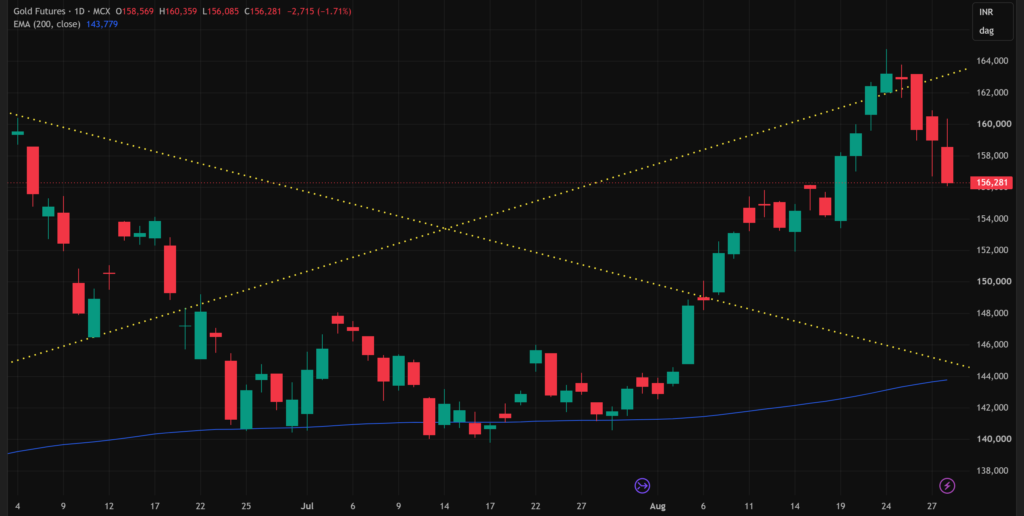
Gold’s medium-term uptrend is intact, but the August 28 price action marks a meaningful change in the short-term structure. The contract closed at ₹156,281, down 1.71%, after reaching ₹160,359 and falling as low as ₹156,085. The 200-day EMA has risen to ₹143,779, so the broader trend is comfortably bullish.
The rally has failed at the rising trendline drawn off the July lows. Price approached the ₹162,000-164,000 area during the advance, traded through it intraday, but could not sustain the move. A sequence of lower closes has followed, culminating in the August 28 bearish candle: gold opened at ₹158,569, rallied briefly to ₹160,359, then sold down to ₹156,085 and closed only marginally above the low. Supply was present throughout the session rather than at a single level. The immediate momentum has shifted from expansion to distribution.
The first test is now ₹155,000-156,000; the August 28 close is sitting directly on it. Holding here would keep the higher-high/higher-low sequence intact. Below that, ₹152,500-154,000 becomes the more important demand zone because it corresponds with the earlier breakout and acceleration phase. A controlled retracement into that band followed by buying would be constructive, turning the near-vertical advance into a more sustainable base.
The bearish case becomes materially stronger only if gold loses ₹152,000-154,000 decisively, exposing ₹149,000-151,000, which would still leave price well above the 200-day EMA. On the upside, ₹158,500-160,000 is the first recovery hurdle. Reclaiming ₹162,000-164,000 and holding above it would invalidate the rejection and restore the momentum structure.
| Key Takeaway: Medium-term uptrend intact; short-term momentum has turned corrective. ₹155,000-156,000 is the pivot. Holding favours consolidation within the broader uptrend; a decisive break below ₹152,000-154,000 opens a deeper retracement toward ₹149,000-151,000. For Indian trade participants, that lower band is also where physical demand typically reappears at scale. |
Silver | MCX SILVER1!
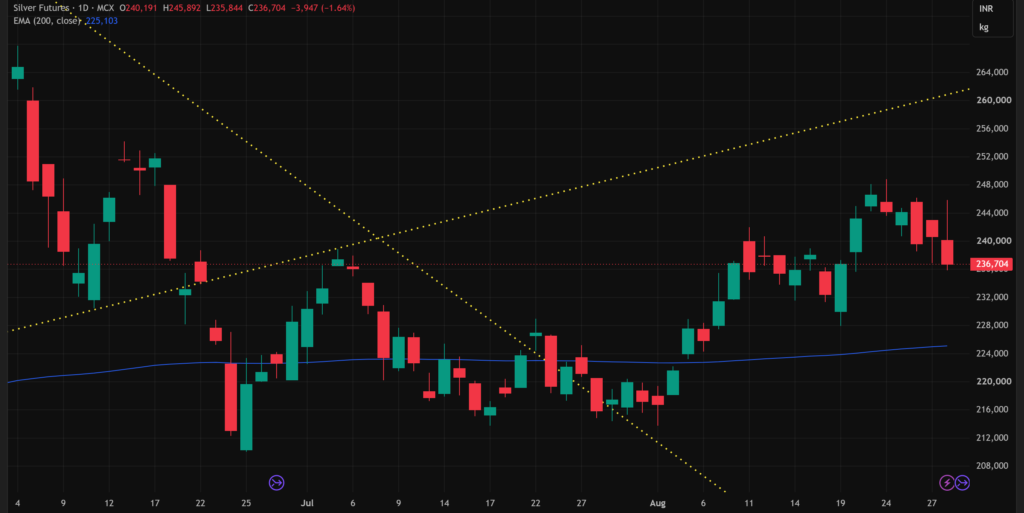
Silver’s medium-term structure is also constructive, but the short-term deterioration is more advanced than in gold. The contract closed at ₹236,704 on August 28, down 1.64%, after trading as high as ₹245,892 and as low as ₹235,844. The 200-day EMA is at ₹225,103.
The move stalled around ₹244,000-248,000, and the sequence of reaction highs has been telling: each attempt above ₹244,000 has produced a less convincing bounce, and the August 28 candle erased much of the August advance while closing near the low. Silver did not simply test ₹245,000 and get pushed back; it failed to recover after the initial rally. Near-term momentum has shifted decisively from expansion to selling pressure.
The immediate test is whether ₹235,000-237,000 holds. The August 28 low of ₹235,844 sits directly in this zone, and there has been repeated interaction around ₹236,000-240,000, so this is where buyers need to demonstrate the decline is corrective. A failure of ₹235,000 makes ₹232,000-233,000 the next test, then the more significant ₹227,000-229,000, and finally the 200-day EMA near ₹225,000. The 200-day is still far enough away that the broader trend remains intact unless the correction becomes materially deeper.
On the upside, silver needs to reclaim ₹240,000-242,000 to repair the immediate damage. Above that, ₹244,000-248,000 is the supply area. A decisive recovery through ₹248,000 would be needed to re-establish the prior momentum regime.
| Key Takeaway: Medium-term structure intact; short-term trend has weakened materially. ₹235,000-237,000 is under immediate pressure. The gold-silver ratio, currently in the high-60s, is the cleaner tell: a re-widening back above 70 while gold holds firm would signal that silver’s industrial-plus-monetary bid is losing to the pure-monetary hedge trade in gold. |
Watch in the Days Ahead
- US August Non-Farm Payrolls (Sep 5). The single most consequential release before the September 16-17 FOMC. A soft print (below 100k) with unemployment ticking higher would put the hike back off the table. A firm print above 175k with steady unemployment would harden the hawkish read and keep pressure on the pivot levels.
- ISM Services (Sep 4). A print above 52 with prices-paid firm extends the sticky-inflation narrative Warsh leaned into. Silver reacts more than gold here because of higher industrial sensitivity.
- Fed speak into the FOMC blackout (Sep 6). Watch whether Governors and regional Presidents echo Warsh’s “6-month annualised at 4.1%” framing or push back. Any dissent is a bullish tell for metals.
- Key technical levels. Gold support ₹155,000-156,000, then ₹152,500-154,000; resistance ₹158,500-160,000, then ₹162,000-164,000. Silver support ₹235,000-237,000, then ₹232,000-233,000, then ₹227,000-229,000; resistance ₹240,000-242,000, then ₹244,000-248,000.
Disclaimer: This column is for informational and educational purposes only and does not constitute investment advice, an offer to buy or sell, or a solicitation of any security or commodity. Data and price levels are sourced from public releases and market data providers as cited. Readers should conduct their own due diligence and consult a licensed advisor before acting.
Authored by Dhawal Chotai