


Macro Snapshot: The week ending May 8 had an unusual rhythm: high-volatility news flow, modest gold gains, and a sharp upmove in silver. Three threads dominated. First, the Hormuz situation took its sharpest turn yet — Iran struck a tanker on Monday and US forces engaged Iranian targets later in the week, briefly sending the rupee to a record low of 95.2 per dollar on Wednesday.
Second, the US sent a one-page Memorandum of Understanding to Iran via Pakistani mediators by mid-week, reportedly aimed at formally ending the conflict and gradually reopening the strait. The peace-deal whisper triggered a sharp drop in oil — Brent fell roughly 7% in a single session — which pushed the rupee back to 94.2 by Friday and lifted gold and silver together on the prospect that the Fed might finally have room to cut rates.
| Metal | Week Ending May 8 | Week Ending May 1 | Change (₹/$) | Change (%) |
| Gold MCX (₹/10g) | ₹1,52,530 | ₹1,51,352 | +₹1,178 | +0.8% |
| Silver MCX (₹/kg) | ₹2,61,922 | ₹2,50,937 | +₹10,985 | +4.4% |
| Gold Comex ($/oz) | $4,730.7 | $4,644.5 | +$86.2 | +1.9% |
| SilverComex ($/oz) | $80.87 | $76.43 | +$4.44 | +5.8% |
Note: All prices are Friday May 8 futures closing prices. MCX prices in INR, COMEX prices in USD. Silver outperformed gold across both exchanges this week, with the gold-silver ratio compressing meaningfully — a clear shift in the relative strength dynamic.
Third, the underlying inflation picture got worse, not better. The April ISM Manufacturing Prices Paid index released on May 1 hit 84.6 — the highest reading since April 2022, with a 25.6-point three-month surge that is the largest in the ISM series’ history. This is the single most important number for precious metals heading into the next two weeks. The Fed is now structurally trapped: it cannot cut rates into 84.6 Prices Paid and 3.5% PCE, but it cannot raise rates into a contracting labour market either. April nonfarm payrolls came in at 115,000 versus the 62,000 consensus expectation, but soft wages and persistent inflation expectations meant gold barely moved. The market is increasingly pricing in policy paralysis.
For India, the dual-engine story this week was the rupee and the silver outperformance. The rupee’s sharp swing — record low Wednesday, sharpest one-day gain in a month on Friday — amplified MCX moves both ways but broadly cushioned domestic prices. MCX gold’s 0.8% gain against COMEX gold’s 1.9% gain shows the mathematics of rupee strength reducing the import-cost translation. Silver was different: MCX silver gained 4.4% against COMEX silver’s 5.8%, with the smaller MCX move reflecting some of the same rupee cushion but the absolute size of both moves indicating that something structural shifted in silver this week.
Kevin Warsh’s Senate Banking Committee confirmation on April 29 was a 13-11 vote — the first fully partisan Fed chair confirmation in committee history. The full Senate vote is expected the week of May 11, ahead of Powell’s May 15 term expiry. Warsh has signalled openness to faster cuts and a more data-dependent communication style. Heading into next week, the Senate confirmation, the FOMC vacuum, the Hormuz negotiations, and US PPI data on May 14 all converge into a very dense event calendar.
Gold I MCX Gold1:
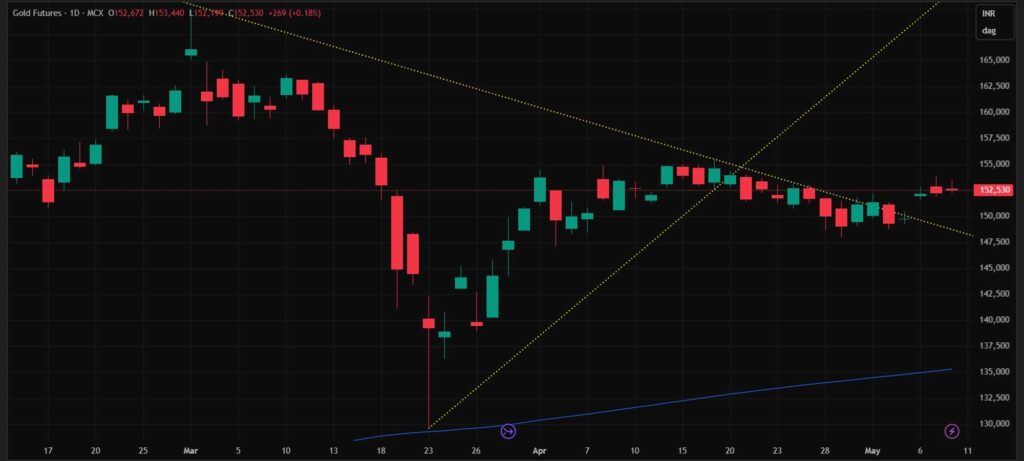
Gold has now spent the past several weeks in what is best described as a stabilization phase rather than a sustained recovery. After correcting sharply from the late-January all-time high near ₹1,81,000 to the March low around ₹1,30,000, price has consolidated within a roughly ₹1,48,000 to ₹1,54,000 range. The candles in the latest sessions continue to show compression and fading directional momentum — small bodies, repeated tests of the same zones, no expansion in either direction.
Although gold closed above the declining trendline during the week ending May 1, follow-through has been limited. The May 8 close at ₹1,52,530 reflects only marginal upside progress rather than decisive acceptance above supply. Recent candles show repeated hesitation around the ₹1,53,500-1,55,000 zone — buyers are preventing breakdowns, but upside attempts are also being absorbed without expansion. Structurally, the impulsive rebound from the March low has slowed into flatter consolidation behaviour.
The earlier breakout attempt above the trendline remains technically valid, but the lack of follow-through is telling. Gold is also showing a notable divergence from its own past behaviour: in May 2019, US-Iran tensions in this same waterway pushed gold up roughly 2% in a single session. This week, even with a tanker strike on Monday and Iranian threats against US forces, gold barely moved. The war risk premium appears largely priced in — only resolution (a Hormuz reopening that cools oil and frees the Fed) would now provide a fresh upward catalyst.
| Key Takeaway: Gold is consolidating after an attempted breakout above the declining trendline. The breakout has not failed outright, but weak follow-through and persistent supply absorption are preventing confirmation of stronger bullish continuation. For jewellers, the ₹1,50,000 zone has held repeatedly as demand and remains the primary level to watch. A daily close above ₹1,55,000 would shift the bias from neutral to bullish; failure to clear that supply zone keeps gold range-bound. Procurement bias: continued tranche-based accumulation in the ₹1,50,000-1,52,000 zone makes more sense than chasing strength. |
Silver I MCX Silver1:
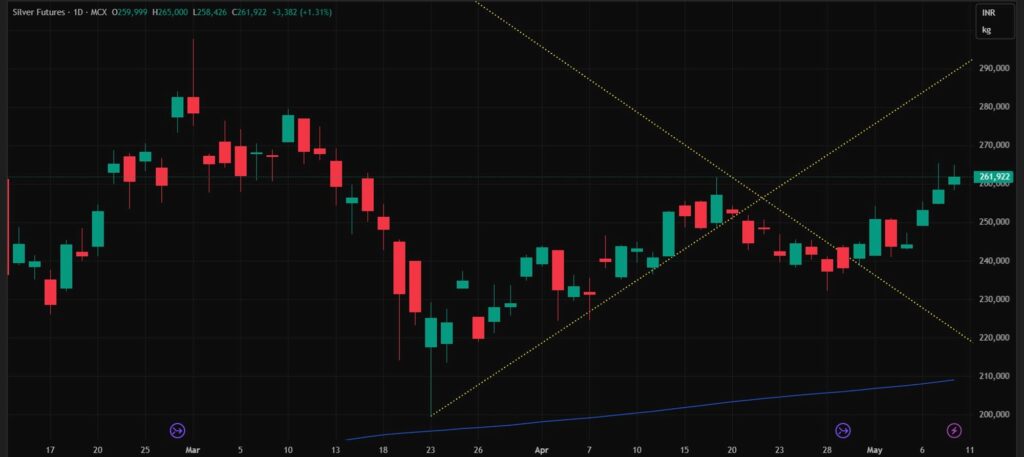
Silver tells a fundamentally different story from gold this week. After correcting from the late-January all-time high near ₹4,20,000 to the March low around ₹1,99,000, silver has shown a steadier and more constructive recovery profile than gold throughout. Demand consistently emerged in the ₹2,25,000-2,30,000 region during the recovery phase, establishing a clearer medium-term demand base before the recent upside expansion.
The breakout above the declining trendline during the week ending May 1 has seen materially stronger follow-through than gold. Prices accelerated higher into the May 8 close at ₹2,61,922, with recent candles showing improving momentum and stronger acceptance above prior consolidation zones. Importantly, the late-April pullback remained corrective and did not invalidate the higher-low structure that had been forming. Buyers are showing better control through higher lows, stronger closes, and sustained acceptance above former resistance areas.
The mechanism behind silver’s outperformance is worth understanding clearly. A Hormuz reopening — which the US-Iran MOU on Wednesday brought into the realm of possibility — gives silver everything gold gets (lower oil, cooling inflation, Fed room to cut) plus the restoration of ten weeks of suppressed industrial demand. Both engines fire at once for silver in a way they cannot for gold. The gold-silver ratio compressed sharply this week to 58.5 from 60.8 last week and 62 the week before. A tightening ratio is the cleanest leading indicator of risk appetite returning to precious metals, and the move this week is the most decisive shift the ratio has shown in over a month.
| Key Takeaway: Silver is now showing increasingly credible breakout confirmation through stronger follow-through buying. Momentum favours continuation rather than a failed breakout reversal. The 200 EMA at approximately ₹2,07,000 is well below current prices, confirming the long-term uptrend is intact. For trade participants with silver exposure, the next major level to watch is ₹2,70,000-2,75,000, where prior supply zones from early March will be tested. A break above that opens the path toward ₹2,90,000-3,00,000. Silver remains the higher-conviction trade between the two metals right now — but also the higher-volatility one. Position sizing matters more for silver than for gold. |
Why Silver is Pulling Away from Gold:
This week’s price action makes one thing clear: silver is materially outperforming gold, and the gap is widening. Both on momentum (a 4.4% MCX gain versus 0.8%) and on structural acceptance above breakout zones, silver is the more credible chart right now. There are three reasons why.
First, silver has dual demand engines. Gold is primarily a safe-haven and inflation hedge; silver is both that and an industrial metal. The Hormuz tensions have suppressed industrial demand globally for ten weeks. Any credible peace progress — like the MOU reportedly delivered through Pakistani mediators on Wednesday — restores that demand alongside the safe-haven bid that benefits gold. Silver wins both ways.
Second, gold’s war premium is already priced in. In May 2019, US-Iran tensions pushed gold up 2% on a single Hormuz incident. This week, with a tanker struck and US forces engaging Iranian targets, gold barely moved. The market has fully absorbed the geopolitical risk premium for gold. Silver, with its industrial demand component still suppressed, has more room to run on positive resolution news.
Third, the gold-silver ratio is mean-reverting. After widening sharply in late April, the ratio has now compressed to 58.5. Historical patterns suggest this kind of move tends to extend further — the long-term average ratio is around 65-70, but during precious-metals bull cycles it has compressed to 40-50. If the structural backdrop continues to favour both metals, the ratio compression is likely to continue, which mathematically means silver outperforms gold in percentage terms.
None of this guarantees silver continues to outperform. A failure of US-Iran peace talks, a sharp oil spike, or a hawkish Warsh confirmation hearing could reverse the move sharply. Silver’s faster movement in both directions is the structural feature, not a bug — but for trade participants and procurement decisions, this week confirms what last week’s article suggested: silver is leading, gold is following, and the gap is widening.
Watch in the Days Ahead:
- US-Iran MOU response: Iran is expected to respond in the coming days to the one-page Memorandum of Understanding delivered through Pakistani mediators. A positive response opens the path to Hormuz reopening, lower oil, and Fed cuts — all bullish for both metals, especially silver. A rejection or escalation would push oil higher and force the Fed deeper into paralysis — complex implications for gold, mostly negative for silver.
- Warsh full Senate vote (week of May 11): After clearing the Senate Banking Committee 13-11 on April 29, the full Senate vote is expected this coming week ahead of Powell’s May 15 term expiry. Warsh’s first communication signals as Fed chair-elect will move precious metals immediately. Any dovish lean is sharply positive for both metals.
- US PPI data (May 14): Will reveal whether the ISM Prices Paid surge to 84.6 is bleeding into actual producer prices. A hot print confirms the stagflation thesis and supports gold structurally; a cooler print would suggest the inflation impulse is moderating and could weaken the precious metals bid in the short term.
- Rupee volatility: The rupee swung from 95.2 (record low) on Wednesday to 94.2 on Friday — a ₹1 range in three sessions. Continued volatility around the Hormuz situation will keep MCX prices moving more sharply than COMEX. Watch for any RBI commentary or visible intervention.
- MCX key levels: Gold: ₹1,55,000 supply (must clear for bullish continuation), ₹1,50,000 demand (must hold). Silver: ₹2,70,000-2,75,000 (next major resistance), ₹2,55,000 (immediate support, must hold to keep momentum intact), ₹2,90,000-3,00,000 (target if ₹2,70,000 breaks).
Disclaimer: This article is for informational purposes only and does not constitute investment or trading advice. All prices are futures closing prices — MCX in INR, COMEX in USD. Past performance is not indicative of future results.
Authored by Dhawal Chotai